Loading...
Searching...
No Matches
plannodes.h File Reference
#include "access/sdir.h"#include "access/stratnum.h"#include "common/relpath.h"#include "lib/stringinfo.h"#include "nodes/bitmapset.h"#include "nodes/lockoptions.h"#include "nodes/primnodes.h"
Include dependency graph for plannodes.h:
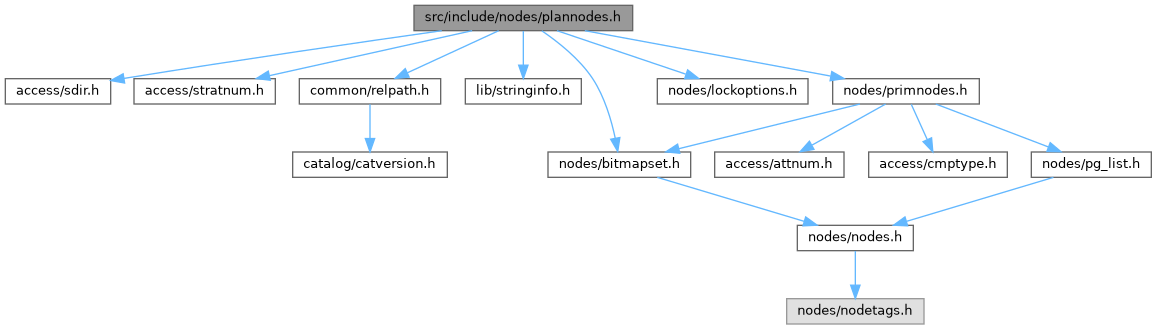
This graph shows which files directly or indirectly include this file:

Go to the source code of this file.
Macros | |
| #define | exec_subplan_get_plan(plannedstmt, subplan) ((Plan *) list_nth((plannedstmt)->subplans, (subplan)->plan_id - 1)) |
| #define | innerPlan(node) (((Plan *)(node))->righttree) |
| #define | outerPlan(node) (((Plan *)(node))->lefttree) |
| #define | RowMarkRequiresRowShareLock(marktype) ((marktype) <= ROW_MARK_KEYSHARE) |
Enumerations | |
| enum | PlannedStmtOrigin { PLAN_STMT_UNKNOWN = 0 , PLAN_STMT_INTERNAL , PLAN_STMT_STANDARD , PLAN_STMT_CACHE_GENERIC , PLAN_STMT_CACHE_CUSTOM } |
| enum | ResultType { RESULT_TYPE_GATING , RESULT_TYPE_SCAN , RESULT_TYPE_JOIN , RESULT_TYPE_UPPER , RESULT_TYPE_MINMAX } |
| enum | SubqueryScanStatus { SUBQUERY_SCAN_UNKNOWN , SUBQUERY_SCAN_TRIVIAL , SUBQUERY_SCAN_NONTRIVIAL } |
| enum | RowMarkType { ROW_MARK_EXCLUSIVE , ROW_MARK_NOKEYEXCLUSIVE , ROW_MARK_SHARE , ROW_MARK_KEYSHARE , ROW_MARK_REFERENCE , ROW_MARK_COPY } |
| enum | PartitionPruneCombineOp { PARTPRUNE_COMBINE_UNION , PARTPRUNE_COMBINE_INTERSECT } |
| enum | MonotonicFunction { MONOTONICFUNC_NONE = 0 , MONOTONICFUNC_INCREASING = (1 << 0) , MONOTONICFUNC_DECREASING = (1 << 1) , MONOTONICFUNC_BOTH = MONOTONICFUNC_INCREASING | MONOTONICFUNC_DECREASING } |
Macro Definition Documentation
◆ exec_subplan_get_plan
| #define exec_subplan_get_plan | ( | plannedstmt, | |
| subplan | |||
| ) | ((Plan *) list_nth((plannedstmt)->subplans, (subplan)->plan_id - 1)) |
Definition at line 175 of file plannodes.h.
191{
193
195
196 /*
197 * estimated execution costs for plan (see costsize.c for more info)
198 */
199 /* count of disabled nodes */
200 int disabled_nodes;
201 /* cost expended before fetching any tuples */
202 Cost startup_cost;
203 /* total cost (assuming all tuples fetched) */
204 Cost total_cost;
205
206 /*
207 * planner's estimate of result size of this plan step
208 */
209 /* number of rows plan is expected to emit */
210 Cardinality plan_rows;
211 /* average row width in bytes */
212 int plan_width;
213
214 /*
215 * information needed for parallel query
216 */
217 /* engage parallel-aware logic? */
218 bool parallel_aware;
219 /* OK to use as part of parallel plan? */
220 bool parallel_safe;
221
222 /*
223 * information needed for asynchronous execution
224 */
225 /* engage asynchronous-capable logic? */
226 bool async_capable;
227
228 /*
229 * Common structural data for all Plan types.
230 */
231 /* unique across entire final plan tree */
232 int plan_node_id;
233 /* target list to be computed at this node */
234 List *targetlist;
235 /* implicitly-ANDed qual conditions */
236 List *qual;
237 /* input plan tree(s) */
240 /* Init Plan nodes (un-correlated expr subselects) */
242
243 /*
244 * Information for management of parameter-change-driven rescanning
245 *
246 * extParam includes the paramIDs of all external PARAM_EXEC params
247 * affecting this plan node or its children. setParam params from the
248 * node's initPlans are not included, but their extParams are.
249 *
250 * allParam includes all the extParam paramIDs, plus the IDs of local
251 * params that affect the node (i.e., the setParams of its initplans).
252 * These are _all_ the PARAM_EXEC params that affect this node.
253 */
256} Plan;
257
258/* ----------------
259 * these are defined to avoid confusion problems with "left"
260 * and "right" and "inner" and "outer". The convention is that
261 * the "left" plan is the "outer" plan and the "right" plan is
262 * the inner plan, but these make the code more readable.
263 * ----------------
264 */
265#define innerPlan(node) (((Plan *)(node))->righttree)
266#define outerPlan(node) (((Plan *)(node))->lefttree)
267
268
269/* ----------------
270 * ResultType -
271 * Classification of Result nodes
272 * ----------------
273 */
275{
281} ResultType;
282
283/* ----------------
284 * Result node -
285 * If no outer plan, evaluate a variable-free targetlist.
286 * If outer plan, return tuples from outer plan (after a level of
287 * projection as shown by targetlist).
288 *
289 * If resconstantqual isn't NULL, it represents a one-time qualification
290 * test (i.e., one that doesn't depend on any variables from the outer plan,
291 * so needs to be evaluated only once).
292 *
293 * relids identifies the relation for which this Result node is generating the
294 * tuples. When subplan is not NULL, it should be empty: this node is not
295 * generating anything in that case, just acting on tuples generated by the
296 * subplan. Otherwise, it contains the relids of the planner relation that
297 * the Result represents.
298 * ----------------
299 */
301{
306} Result;
307
308/* ----------------
309 * ProjectSet node -
310 * Apply a projection that includes set-returning functions to the
311 * output tuples of the outer plan.
312 * ----------------
313 */
315{
317} ProjectSet;
318
319/* ----------------
320 * ModifyTable node -
321 * Apply rows produced by outer plan to result table(s),
322 * by inserting, updating, or deleting.
323 *
324 * If the originally named target table is a partitioned table or inheritance
325 * tree, both nominalRelation and rootRelation contain the RT index of the
326 * partition root or appendrel RTE, which is not otherwise mentioned in the
327 * plan. Otherwise rootRelation is zero. However, nominalRelation will
328 * always be set, as it's the rel that EXPLAIN should claim is the
329 * INSERT/UPDATE/DELETE/MERGE target.
330 *
331 * Note that rowMarks and epqParam are presumed to be valid for all the
332 * table(s); they can't contain any info that varies across tables.
333 * ----------------
334 */
336{
338 /* INSERT, UPDATE, DELETE, or MERGE */
340 /* do we set the command tag/es_processed? */
342 /* Parent RT index for use of EXPLAIN */
344 /* Root RT index, if partitioned/inherited */
346 /* integer list of RT indexes */
348 /* per-target-table update_colnos lists */
350 /* per-target-table WCO lists */
352 /* alias for OLD in RETURNING lists */
354 /* alias for NEW in RETURNING lists */
356 /* per-target-table RETURNING tlists */
358 /* per-target-table FDW private data lists */
360 /* indices of FDW DM plans */
362 /* PlanRowMarks (non-locking only) */
364 /* ID of Param for EvalPlanQual re-eval */
366 /* ON CONFLICT action */
368 /* List of ON CONFLICT arbiter index OIDs */
370 /* lock strength for ON CONFLICT DO SELECT */
372 /* INSERT ON CONFLICT DO UPDATE targetlist */
374 /* target column numbers for onConflictSet */
376 /* WHERE for ON CONFLICT DO SELECT/UPDATE */
378 /* RTI of the EXCLUDED pseudo relation */
380 /* tlist of the EXCLUDED pseudo relation */
382 /* per-target-table lists of actions for MERGE */
384 /* per-target-table join conditions for MERGE */
386} ModifyTable;
387
389
390/* ----------------
391 * Append node -
392 * Generate the concatenation of the results of sub-plans.
393 * ----------------
394 */
396{
398
399 /* RTIs of appendrel(s) formed by this node */
401
402 /* sets of RTIs of appendrels consolidated into this node */
404
405 /* plans to run */
407
408 /* # of asynchronous plans */
410
411 /*
412 * All 'appendplans' preceding this index are non-partial plans. All
413 * 'appendplans' from this index onwards are partial plans.
414 */
416
417 /*
418 * Index into PlannedStmt.partPruneInfos and parallel lists in EState:
419 * es_part_prune_states and es_part_prune_results. Set to -1 if no
420 * run-time pruning is used.
421 */
423} Append;
424
425/* ----------------
426 * MergeAppend node -
427 * Merge the results of pre-sorted sub-plans to preserve the ordering.
428 * ----------------
429 */
431{
433
434 /* RTIs of appendrel(s) formed by this node */
436
437 /* sets of RTIs of appendrels consolidated into this node */
439
440 /* plans to run */
442
443 /* these fields are just like the sort-key info in struct Sort: */
444
445 /* number of sort-key columns */
447
448 /* their indexes in the target list */
450
451 /* OIDs of operators to sort them by */
453
454 /* OIDs of collations */
456
457 /* NULLS FIRST/LAST directions */
459
460 /*
461 * Index into PlannedStmt.partPruneInfos and parallel lists in EState:
462 * es_part_prune_states and es_part_prune_results. Set to -1 if no
463 * run-time pruning is used.
464 */
466} MergeAppend;
467
468/* ----------------
469 * RecursiveUnion node -
470 * Generate a recursive union of two subplans.
471 *
472 * The "outer" subplan is always the non-recursive term, and the "inner"
473 * subplan is the recursive term.
474 * ----------------
475 */
477{
479
480 /* ID of Param representing work table */
482
483 /* Remaining fields are zero/null in UNION ALL case */
484
485 /* number of columns to check for duplicate-ness */
487
488 /* their indexes in the target list */
490
491 /* equality operators to compare with */
494
495 /* estimated number of groups in input */
497} RecursiveUnion;
498
499/* ----------------
500 * BitmapAnd node -
501 * Generate the intersection of the results of sub-plans.
502 *
503 * The subplans must be of types that yield tuple bitmaps. The targetlist
504 * and qual fields of the plan are unused and are always NIL.
505 * ----------------
506 */
508{
511} BitmapAnd;
512
513/* ----------------
514 * BitmapOr node -
515 * Generate the union of the results of sub-plans.
516 *
517 * The subplans must be of types that yield tuple bitmaps. The targetlist
518 * and qual fields of the plan are unused and are always NIL.
519 * ----------------
520 */
522{
526} BitmapOr;
527
528/*
529 * ==========
530 * Scan nodes
531 *
532 * Scan is an abstract type that all relation scan plan types inherit from.
533 * ==========
534 */
536{
538
540 /* relid is index into the range table */
542} Scan;
543
544/* ----------------
545 * sequential scan node
546 * ----------------
547 */
549{
550 Scan scan;
551} SeqScan;
552
553/* ----------------
554 * table sample scan node
555 * ----------------
556 */
558{
559 Scan scan;
560 /* use struct pointer to avoid including parsenodes.h here */
562} SampleScan;
563
564/* ----------------
565 * index scan node
566 *
567 * indexqualorig is an implicitly-ANDed list of index qual expressions, each
568 * in the same form it appeared in the query WHERE condition. Each should
569 * be of the form (indexkey OP comparisonval) or (comparisonval OP indexkey).
570 * The indexkey is a Var or expression referencing column(s) of the index's
571 * base table. The comparisonval might be any expression, but it won't use
572 * any columns of the base table. The expressions are ordered by index
573 * column position (but items referencing the same index column can appear
574 * in any order). indexqualorig is used at runtime only if we have to recheck
575 * a lossy indexqual.
576 *
577 * indexqual has the same form, but the expressions have been commuted if
578 * necessary to put the indexkeys on the left, and the indexkeys are replaced
579 * by Var nodes identifying the index columns (their varno is INDEX_VAR and
580 * their varattno is the index column number).
581 *
582 * indexorderbyorig is similarly the original form of any ORDER BY expressions
583 * that are being implemented by the index, while indexorderby is modified to
584 * have index column Vars on the left-hand side. Here, multiple expressions
585 * must appear in exactly the ORDER BY order, and this is not necessarily the
586 * index column order. Only the expressions are provided, not the auxiliary
587 * sort-order information from the ORDER BY SortGroupClauses; it's assumed
588 * that the sort ordering is fully determinable from the top-level operators.
589 * indexorderbyorig is used at runtime to recheck the ordering, if the index
590 * cannot calculate an accurate ordering. It is also needed for EXPLAIN.
591 *
592 * indexorderbyops is a list of the OIDs of the operators used to sort the
593 * ORDER BY expressions. This is used together with indexorderbyorig to
594 * recheck ordering at run time. (Note that indexorderby, indexorderbyorig,
595 * and indexorderbyops are used for amcanorderbyop cases, not amcanorder.)
596 *
597 * indexorderdir specifies the scan ordering, for indexscans on amcanorder
598 * indexes (for other indexes it should be "don't care").
599 * ----------------
600 */
602{
603 Scan scan;
604 /* OID of index to scan */
605 Oid indexid;
606 /* list of index quals (usually OpExprs) */
607 List *indexqual;
608 /* the same in original form */
609 List *indexqualorig;
610 /* list of index ORDER BY exprs */
611 List *indexorderby;
612 /* the same in original form */
613 List *indexorderbyorig;
614 /* OIDs of sort ops for ORDER BY exprs */
615 List *indexorderbyops;
616 /* forward or backward or don't care */
617 ScanDirection indexorderdir;
618} IndexScan;
619
620/* ----------------
621 * index-only scan node
622 *
623 * IndexOnlyScan is very similar to IndexScan, but it specifies an
624 * index-only scan, in which the data comes from the index not the heap.
625 * Because of this, *all* Vars in the plan node's targetlist, qual, and
626 * index expressions reference index columns and have varno = INDEX_VAR.
627 *
628 * We could almost use indexqual directly against the index's output tuple
629 * when rechecking lossy index operators, but that won't work for quals on
630 * index columns that are not retrievable. Hence, recheckqual is needed
631 * for rechecks: it expresses the same condition as indexqual, but using
632 * only index columns that are retrievable. (We will not generate an
633 * index-only scan if this is not possible. An example is that if an
634 * index has table column "x" in a retrievable index column "ind1", plus
635 * an expression f(x) in a non-retrievable column "ind2", an indexable
636 * query on f(x) will use "ind2" in indexqual and f(ind1) in recheckqual.
637 * Without the "ind1" column, an index-only scan would be disallowed.)
638 *
639 * We don't currently need a recheckable equivalent of indexorderby,
640 * because we don't support lossy operators in index ORDER BY.
641 *
642 * To help EXPLAIN interpret the index Vars for display, we provide
643 * indextlist, which represents the contents of the index as a targetlist
644 * with one TLE per index column. Vars appearing in this list reference
645 * the base table, and this is the only field in the plan node that may
646 * contain such Vars. Also, for the convenience of setrefs.c, TLEs in
647 * indextlist are marked as resjunk if they correspond to columns that
648 * the index AM cannot reconstruct.
649 * ----------------
650 */
652{
653 Scan scan;
654 /* OID of index to scan */
655 Oid indexid;
656 /* list of index quals (usually OpExprs) */
657 List *indexqual;
658 /* index quals in recheckable form */
659 List *recheckqual;
660 /* list of index ORDER BY exprs */
661 List *indexorderby;
662 /* TargetEntry list describing index's cols */
663 List *indextlist;
664 /* forward or backward or don't care */
665 ScanDirection indexorderdir;
666} IndexOnlyScan;
667
668/* ----------------
669 * bitmap index scan node
670 *
671 * BitmapIndexScan delivers a bitmap of potential tuple locations;
672 * it does not access the heap itself. The bitmap is used by an
673 * ancestor BitmapHeapScan node, possibly after passing through
674 * intermediate BitmapAnd and/or BitmapOr nodes to combine it with
675 * the results of other BitmapIndexScans.
676 *
677 * The fields have the same meanings as for IndexScan, except we don't
678 * store a direction flag because direction is uninteresting.
679 *
680 * In a BitmapIndexScan plan node, the targetlist and qual fields are
681 * not used and are always NIL. The indexqualorig field is unused at
682 * run time too, but is saved for the benefit of EXPLAIN.
683 * ----------------
684 */
686{
687 Scan scan;
688 /* OID of index to scan */
689 Oid indexid;
690 /* Create shared bitmap if set */
691 bool isshared;
692 /* list of index quals (OpExprs) */
693 List *indexqual;
694 /* the same in original form */
695 List *indexqualorig;
696} BitmapIndexScan;
697
698/* ----------------
699 * bitmap sequential scan node
700 *
701 * This needs a copy of the qual conditions being used by the input index
702 * scans because there are various cases where we need to recheck the quals;
703 * for example, when the bitmap is lossy about the specific rows on a page
704 * that meet the index condition.
705 * ----------------
706 */
708{
709 Scan scan;
710 /* index quals, in standard expr form */
711 List *bitmapqualorig;
712} BitmapHeapScan;
713
714/* ----------------
715 * tid scan node
716 *
717 * tidquals is an implicitly OR'ed list of qual expressions of the form
718 * "CTID = pseudoconstant", or "CTID = ANY(pseudoconstant_array)",
719 * or a CurrentOfExpr for the relation.
720 * ----------------
721 */
723{
724 Scan scan;
725 /* qual(s) involving CTID = something */
726 List *tidquals;
727} TidScan;
728
729/* ----------------
730 * tid range scan node
731 *
732 * tidrangequals is an implicitly AND'ed list of qual expressions of the form
733 * "CTID relop pseudoconstant", where relop is one of >,>=,<,<=.
734 * ----------------
735 */
737{
738 Scan scan;
739 /* qual(s) involving CTID op something */
740 List *tidrangequals;
741} TidRangeScan;
742
743/* ----------------
744 * subquery scan node
745 *
746 * SubqueryScan is for scanning the output of a sub-query in the range table.
747 * We often need an extra plan node above the sub-query's plan to perform
748 * expression evaluations (which we can't push into the sub-query without
749 * risking changing its semantics). Although we are not scanning a physical
750 * relation, we make this a descendant of Scan anyway for code-sharing
751 * purposes.
752 *
753 * SubqueryScanStatus caches the trivial_subqueryscan property of the node.
754 * SUBQUERY_SCAN_UNKNOWN means not yet determined. This is only used during
755 * planning.
756 *
757 * Note: we store the sub-plan in the type-specific subplan field, not in
758 * the generic lefttree field as you might expect. This is because we do
759 * not want plan-tree-traversal routines to recurse into the subplan without
760 * knowing that they are changing Query contexts.
761 * ----------------
762 */
764{
768} SubqueryScanStatus;
769
771{
772 Scan scan;
773 Plan *subplan;
774 SubqueryScanStatus scanstatus;
775} SubqueryScan;
776
777/* ----------------
778 * FunctionScan node
779 * ----------------
780 */
782{
783 Scan scan;
784 /* list of RangeTblFunction nodes */
786 /* WITH ORDINALITY */
787 bool funcordinality;
788} FunctionScan;
789
790/* ----------------
791 * ValuesScan node
792 * ----------------
793 */
795{
796 Scan scan;
797 /* list of expression lists */
798 List *values_lists;
799} ValuesScan;
800
801/* ----------------
802 * TableFunc scan node
803 * ----------------
804 */
806{
807 Scan scan;
808 /* table function node */
809 TableFunc *tablefunc;
810} TableFuncScan;
811
812/* ----------------
813 * CteScan node
814 * ----------------
815 */
817{
818 Scan scan;
819 /* ID of init SubPlan for CTE */
820 int ctePlanId;
821 /* ID of Param representing CTE output */
822 int cteParam;
823} CteScan;
824
825/* ----------------
826 * NamedTuplestoreScan node
827 * ----------------
828 */
830{
831 Scan scan;
832 /* Name given to Ephemeral Named Relation */
833 char *enrname;
834} NamedTuplestoreScan;
835
836/* ----------------
837 * WorkTableScan node
838 * ----------------
839 */
841{
842 Scan scan;
843 /* ID of Param representing work table */
844 int wtParam;
845} WorkTableScan;
846
847/* ----------------
848 * ForeignScan node
849 *
850 * fdw_exprs and fdw_private are both under the control of the foreign-data
851 * wrapper, but fdw_exprs is presumed to contain expression trees and will
852 * be post-processed accordingly by the planner; fdw_private won't be.
853 * Note that everything in both lists must be copiable by copyObject().
854 * One way to store an arbitrary blob of bytes is to represent it as a bytea
855 * Const. Usually, though, you'll be better off choosing a representation
856 * that can be dumped usefully by nodeToString().
857 *
858 * fdw_scan_tlist is a targetlist describing the contents of the scan tuple
859 * returned by the FDW; it can be NIL if the scan tuple matches the declared
860 * rowtype of the foreign table, which is the normal case for a simple foreign
861 * table scan. (If the plan node represents a foreign join, fdw_scan_tlist
862 * is required since there is no rowtype available from the system catalogs.)
863 * When fdw_scan_tlist is provided, Vars in the node's tlist and quals must
864 * have varno INDEX_VAR, and their varattnos correspond to resnos in the
865 * fdw_scan_tlist (which are also column numbers in the actual scan tuple).
866 * fdw_scan_tlist is never actually executed; it just holds expression trees
867 * describing what is in the scan tuple's columns.
868 *
869 * fdw_recheck_quals should contain any quals which the core system passed to
870 * the FDW but which were not added to scan.plan.qual; that is, it should
871 * contain the quals being checked remotely. This is needed for correct
872 * behavior during EvalPlanQual rechecks.
873 *
874 * When the plan node represents a foreign join, scan.scanrelid is zero and
875 * fs_relids must be consulted to identify the join relation. (fs_relids
876 * is valid for simple scans as well, but will always match scan.scanrelid.)
877 * fs_relids includes outer joins; fs_base_relids does not.
878 *
879 * If the FDW's PlanDirectModify() callback decides to repurpose a ForeignScan
880 * node to perform the UPDATE or DELETE operation directly in the remote
881 * server, it sets 'operation' and 'resultRelation' to identify the operation
882 * type and target relation. Note that these fields are only set if the
883 * modification is performed *fully* remotely; otherwise, the modification is
884 * driven by a local ModifyTable node and 'operation' is left to CMD_SELECT.
885 * ----------------
886 */
888{
889 Scan scan;
890 /* SELECT/INSERT/UPDATE/DELETE */
891 CmdType operation;
892 /* direct modification target's RT index */
893 Index resultRelation;
894 /* user to perform the scan as; 0 means to check as current user */
895 Oid checkAsUser;
896 /* OID of foreign server */
897 Oid fs_server;
898 /* expressions that FDW may evaluate */
899 List *fdw_exprs;
900 /* private data for FDW */
901 List *fdw_private;
902 /* optional tlist describing scan tuple */
903 List *fdw_scan_tlist;
904 /* original quals not in scan.plan.qual */
905 List *fdw_recheck_quals;
906 /* base+OJ RTIs generated by this scan */
907 Bitmapset *fs_relids;
908 /* base RTIs generated by this scan */
909 Bitmapset *fs_base_relids;
910 /* true if any "system column" is needed */
911 bool fsSystemCol;
912} ForeignScan;
913
914/* ----------------
915 * CustomScan node
916 *
917 * The comments for ForeignScan's fdw_exprs, fdw_private, fdw_scan_tlist,
918 * and fs_relids fields apply equally to CustomScan's custom_exprs,
919 * custom_private, custom_scan_tlist, and custom_relids fields. The
920 * convention of setting scan.scanrelid to zero for joins applies as well.
921 *
922 * Note that since Plan trees can be copied, custom scan providers *must*
923 * fit all plan data they need into those fields; embedding CustomScan in
924 * a larger struct will not work.
925 * ----------------
926 */
928
930{
931 Scan scan;
932 /* mask of CUSTOMPATH_* flags, see nodes/extensible.h */
933 uint32 flags;
934 /* list of Plan nodes, if any */
935 List *custom_plans;
936 /* expressions that custom code may evaluate */
937 List *custom_exprs;
938 /* private data for custom code */
939 List *custom_private;
940 /* optional tlist describing scan tuple */
941 List *custom_scan_tlist;
942 /* RTIs generated by this scan */
943 Bitmapset *custom_relids;
944
945 /*
946 * NOTE: The method field of CustomScan is required to be a pointer to a
947 * static table of callback functions. So we don't copy the table itself,
948 * just reference the original one.
949 */
951} CustomScan;
952
953/*
954 * ==========
955 * Join nodes
956 * ==========
957 */
958
959/* ----------------
960 * Join node
961 *
962 * jointype: rule for joining tuples from left and right subtrees
963 * inner_unique each outer tuple can match to no more than one inner tuple
964 * joinqual: qual conditions that came from JOIN/ON or JOIN/USING
965 * (plan.qual contains conditions that came from WHERE)
966 *
967 * When jointype is INNER, joinqual and plan.qual are semantically
968 * interchangeable. For OUTER jointypes, the two are *not* interchangeable;
969 * only joinqual is used to determine whether a match has been found for
970 * the purpose of deciding whether to generate null-extended tuples.
971 * (But plan.qual is still applied before actually returning a tuple.)
972 * For an outer join, only joinquals are allowed to be used as the merge
973 * or hash condition of a merge or hash join.
974 *
975 * inner_unique is set if the joinquals are such that no more than one inner
976 * tuple could match any given outer tuple. This allows the executor to
977 * skip searching for additional matches. (This must be provable from just
978 * the joinquals, ignoring plan.qual, due to where the executor tests it.)
979 * ----------------
980 */
982{
984
986 JoinType jointype;
987 bool inner_unique;
988 /* JOIN quals (in addition to plan.qual) */
989 List *joinqual;
990} Join;
991
992/* ----------------
993 * nest loop join node
994 *
995 * The nestParams list identifies any executor Params that must be passed
996 * into execution of the inner subplan carrying values from the current row
997 * of the outer subplan. Currently we restrict these values to be simple
998 * Vars, but perhaps someday that'd be worth relaxing. (Note: during plan
999 * creation, the paramval can actually be a PlaceHolderVar expression; but it
1000 * must be a Var with varno OUTER_VAR by the time it gets to the executor.)
1001 * ----------------
1002 */
1004{
1005 Join join;
1006 /* list of NestLoopParam nodes */
1007 List *nestParams;
1008} NestLoop;
1009
1011{
1013
1015 /* number of the PARAM_EXEC Param to set */
1016 int paramno;
1017 /* outer-relation Var to assign to Param */
1018 Var *paramval;
1019} NestLoopParam;
1020
1021/* ----------------
1022 * merge join node
1023 *
1024 * The expected ordering of each mergeable column is described by a btree
1025 * opfamily OID, a collation OID, a direction (BTLessStrategyNumber or
1026 * BTGreaterStrategyNumber) and a nulls-first flag. Note that the two sides
1027 * of each mergeclause may be of different datatypes, but they are ordered the
1028 * same way according to the common opfamily and collation. The operator in
1029 * each mergeclause must be an equality operator of the indicated opfamily.
1030 * ----------------
1031 */
1033{
1034 Join join;
1035
1036 /* Can we skip mark/restore calls? */
1037 bool skip_mark_restore;
1038
1039 /* mergeclauses as expression trees */
1040 List *mergeclauses;
1041
1042 /* these are arrays, but have the same length as the mergeclauses list: */
1043
1044 /* per-clause OIDs of btree opfamilies */
1046
1047 /* per-clause OIDs of collations */
1049
1050 /* per-clause ordering (ASC or DESC) */
1052
1053 /* per-clause nulls ordering */
1055} MergeJoin;
1056
1057/* ----------------
1058 * hash join node
1059 * ----------------
1060 */
1062{
1063 Join join;
1064 List *hashclauses;
1065 List *hashoperators;
1066 List *hashcollations;
1067
1068 /*
1069 * List of expressions to be hashed for tuples from the outer plan, to
1070 * perform lookups in the hashtable over the inner plan.
1071 */
1072 List *hashkeys;
1073} HashJoin;
1074
1075/* ----------------
1076 * materialization node
1077 * ----------------
1078 */
1080{
1082} Material;
1083
1084/* ----------------
1085 * memoize node
1086 * ----------------
1087 */
1089{
1091
1092 /* size of the two arrays below */
1093 int numKeys;
1094
1095 /* hash operators for each key */
1097
1098 /* collations for each key */
1100
1101 /* cache keys in the form of exprs containing parameters */
1102 List *param_exprs;
1103
1104 /*
1105 * true if the cache entry should be marked as complete after we store the
1106 * first tuple in it.
1107 */
1108 bool singlerow;
1109
1110 /*
1111 * true when cache key should be compared bit by bit, false when using
1112 * hash equality ops
1113 */
1114 bool binary_mode;
1115
1116 /*
1117 * The maximum number of entries that the planner expects will fit in the
1118 * cache, or 0 if unknown
1119 */
1120 uint32 est_entries;
1121
1122 /* paramids from param_exprs */
1123 Bitmapset *keyparamids;
1124
1125 /* Estimated number of rescans, for EXPLAIN */
1126 Cardinality est_calls;
1127
1128 /* Estimated number of distinct lookup keys, for EXPLAIN */
1129 Cardinality est_unique_keys;
1130
1131 /* Estimated cache hit ratio, for EXPLAIN */
1132 double est_hit_ratio;
1133
1134} Memoize;
1135
1136/* ----------------
1137 * sort node
1138 * ----------------
1139 */
1141{
1143
1144 /* number of sort-key columns */
1145 int numCols;
1146
1147 /* their indexes in the target list */
1149
1150 /* OIDs of operators to sort them by */
1152
1153 /* OIDs of collations */
1155
1156 /* NULLS FIRST/LAST directions */
1158} Sort;
1159
1160/* ----------------
1161 * incremental sort node
1162 * ----------------
1163 */
1165{
1167 /* number of presorted columns */
1168 int nPresortedCols;
1169} IncrementalSort;
1170
1171/* ---------------
1172 * group node -
1173 * Used for queries with GROUP BY (but no aggregates) specified.
1174 * The input must be presorted according to the grouping columns.
1175 * ---------------
1176 */
1178{
1180
1181 /* number of grouping columns */
1182 int numCols;
1183
1184 /* their indexes in the target list */
1186
1187 /* equality operators to compare with */
1190} Group;
1191
1192/* ---------------
1193 * aggregate node
1194 *
1195 * An Agg node implements plain or grouped aggregation. For grouped
1196 * aggregation, we can work with presorted input or unsorted input;
1197 * the latter strategy uses an internal hashtable.
1198 *
1199 * Notice the lack of any direct info about the aggregate functions to be
1200 * computed. They are found by scanning the node's tlist and quals during
1201 * executor startup. (It is possible that there are no aggregate functions;
1202 * this could happen if they get optimized away by constant-folding, or if
1203 * we are using the Agg node to implement hash-based grouping.)
1204 * ---------------
1205 */
1207{
1209
1210 /* basic strategy, see nodes.h */
1211 AggStrategy aggstrategy;
1212
1213 /* agg-splitting mode, see nodes.h */
1214 AggSplit aggsplit;
1215
1216 /* number of grouping columns */
1217 int numCols;
1218
1219 /* their indexes in the target list */
1221
1222 /* equality operators to compare with */
1225
1226 /* estimated number of groups in input */
1227 Cardinality numGroups;
1228
1229 /* for pass-by-ref transition data */
1230 uint64 transitionSpace;
1231
1232 /* IDs of Params used in Aggref inputs */
1233 Bitmapset *aggParams;
1234
1235 /* Note: planner provides numGroups & aggParams only in HASHED/MIXED case */
1236
1237 /* grouping sets to use */
1238 List *groupingSets;
1239
1240 /* chained Agg/Sort nodes */
1241 List *chain;
1242} Agg;
1243
1244/* ----------------
1245 * window aggregate node
1246 * ----------------
1247 */
1249{
1251
1252 /* name of WindowClause implemented by this node */
1253 char *winname;
1254
1255 /* ID referenced by window functions */
1256 Index winref;
1257
1258 /* number of columns in partition clause */
1259 int partNumCols;
1260
1261 /* their indexes in the target list */
1263
1264 /* equality operators for partition columns */
1266
1267 /* collations for partition columns */
1269
1270 /* number of columns in ordering clause */
1271 int ordNumCols;
1272
1273 /* their indexes in the target list */
1275
1276 /* equality operators for ordering columns */
1278
1279 /* collations for ordering columns */
1281
1282 /* frame_clause options, see WindowDef */
1283 int frameOptions;
1284
1285 /* expression for starting bound, if any */
1286 Node *startOffset;
1287
1288 /* expression for ending bound, if any */
1289 Node *endOffset;
1290
1291 /* qual to help short-circuit execution */
1292 List *runCondition;
1293
1294 /* runCondition for display in EXPLAIN */
1295 List *runConditionOrig;
1296
1297 /* these fields are used with RANGE offset PRECEDING/FOLLOWING: */
1298
1299 /* in_range function for startOffset */
1300 Oid startInRangeFunc;
1301
1302 /* in_range function for endOffset */
1303 Oid endInRangeFunc;
1304
1305 /* collation for in_range tests */
1306 Oid inRangeColl;
1307
1308 /* use ASC sort order for in_range tests? */
1309 bool inRangeAsc;
1310
1311 /* nulls sort first for in_range tests? */
1312 bool inRangeNullsFirst;
1313
1314 /*
1315 * false for all apart from the WindowAgg that's closest to the root of
1316 * the plan
1317 */
1318 bool topWindow;
1319} WindowAgg;
1320
1321/* ----------------
1322 * unique node
1323 * ----------------
1324 */
1326{
1328
1329 /* number of columns to check for uniqueness */
1330 int numCols;
1331
1332 /* their indexes in the target list */
1334
1335 /* equality operators to compare with */
1337
1338 /* collations for equality comparisons */
1340} Unique;
1341
1342/* ------------
1343 * gather node
1344 *
1345 * Note: rescan_param is the ID of a PARAM_EXEC parameter slot. That slot
1346 * will never actually contain a value, but the Gather node must flag it as
1347 * having changed whenever it is rescanned. The child parallel-aware scan
1348 * nodes are marked as depending on that parameter, so that the rescan
1349 * machinery is aware that their output is likely to change across rescans.
1350 * In some cases we don't need a rescan Param, so rescan_param is set to -1.
1351 * ------------
1352 */
1354{
1356 /* planned number of worker processes */
1357 int num_workers;
1358 /* ID of Param that signals a rescan, or -1 */
1359 int rescan_param;
1360 /* don't execute plan more than once */
1361 bool single_copy;
1362 /* suppress EXPLAIN display (for testing)? */
1363 bool invisible;
1364
1365 /*
1366 * param id's of initplans which are referred at gather or one of its
1367 * child nodes
1368 */
1369 Bitmapset *initParam;
1370} Gather;
1371
1372/* ------------
1373 * gather merge node
1374 * ------------
1375 */
1377{
1379
1380 /* planned number of worker processes */
1381 int num_workers;
1382
1383 /* ID of Param that signals a rescan, or -1 */
1384 int rescan_param;
1385
1386 /* remaining fields are just like the sort-key info in struct Sort */
1387
1388 /* number of sort-key columns */
1389 int numCols;
1390
1391 /* their indexes in the target list */
1393
1394 /* OIDs of operators to sort them by */
1396
1397 /* OIDs of collations */
1399
1400 /* NULLS FIRST/LAST directions */
1402
1403 /*
1404 * param id's of initplans which are referred at gather merge or one of
1405 * its child nodes
1406 */
1407 Bitmapset *initParam;
1408} GatherMerge;
1409
1410/* ----------------
1411 * hash build node
1412 *
1413 * If the executor is supposed to try to apply skew join optimization, then
1414 * skewTable/skewColumn/skewInherit identify the outer relation's join key
1415 * column, from which the relevant MCV statistics can be fetched.
1416 * ----------------
1417 */
1419{
1421
1422 /*
1423 * List of expressions to be hashed for tuples from Hash's outer plan,
1424 * needed to put them into the hashtable.
1425 */
1426 /* hash keys for the hashjoin condition */
1427 List *hashkeys;
1428 /* outer join key's table OID, or InvalidOid */
1429 Oid skewTable;
1430 /* outer join key's column #, or zero */
1431 AttrNumber skewColumn;
1432 /* is outer join rel an inheritance tree? */
1433 bool skewInherit;
1434 /* all other info is in the parent HashJoin node */
1435 /* estimate total rows if parallel_aware */
1436 Cardinality rows_total;
1437} Hash;
1438
1439/* ----------------
1440 * setop node
1441 * ----------------
1442 */
1444{
1446
1447 /* what to do, see nodes.h */
1448 SetOpCmd cmd;
1449
1450 /* how to do it, see nodes.h */
1451 SetOpStrategy strategy;
1452
1453 /* number of columns to compare */
1454 int numCols;
1455
1456 /* their indexes in the target list */
1458
1459 /* comparison operators (either equality operators or sort operators) */
1462
1463 /* nulls-first flags if sorting, otherwise not interesting */
1465
1466 /* estimated number of groups in left input */
1467 Cardinality numGroups;
1468} SetOp;
1469
1470/* ----------------
1471 * lock-rows node
1472 *
1473 * rowMarks identifies the rels to be locked by this node; it should be
1474 * a subset of the rowMarks listed in the top-level PlannedStmt.
1475 * epqParam is a Param that all scan nodes below this one must depend on.
1476 * It is used to force re-evaluation of the plan during EvalPlanQual.
1477 * ----------------
1478 */
1480{
1482 /* a list of PlanRowMark's */
1483 List *rowMarks;
1484 /* ID of Param for EvalPlanQual re-eval */
1485 int epqParam;
1486} LockRows;
1487
1488/* ----------------
1489 * limit node
1490 *
1491 * Note: as of Postgres 8.2, the offset and count expressions are expected
1492 * to yield int8, rather than int4 as before.
1493 * ----------------
1494 */
1496{
1498
1499 /* OFFSET parameter, or NULL if none */
1500 Node *limitOffset;
1501
1502 /* COUNT parameter, or NULL if none */
1503 Node *limitCount;
1504
1505 /* limit type */
1506 LimitOption limitOption;
1507
1508 /* number of columns to check for similarity */
1509 int uniqNumCols;
1510
1511 /* their indexes in the target list */
1513
1514 /* equality operators to compare with */
1516
1517 /* collations for equality comparisons */
1519} Limit;
1520
1521
1522/*
1523 * RowMarkType -
1524 * enums for types of row-marking operations
1525 *
1526 * The first four of these values represent different lock strengths that
1527 * we can take on tuples according to SELECT FOR [KEY] UPDATE/SHARE requests.
1528 * We support these on regular tables, as well as on foreign tables whose FDWs
1529 * report support for late locking. For other foreign tables, any locking
1530 * that might be done for such requests must happen during the initial row
1531 * fetch; their FDWs provide no mechanism for going back to lock a row later.
1532 * This means that the semantics will be a bit different than for a local
1533 * table; in particular we are likely to lock more rows than would be locked
1534 * locally, since remote rows will be locked even if they then fail
1535 * locally-checked restriction or join quals. However, the prospect of
1536 * doing a separate remote query to lock each selected row is usually pretty
1537 * unappealing, so early locking remains a credible design choice for FDWs.
1538 *
1539 * When doing UPDATE/DELETE/MERGE/SELECT FOR UPDATE/SHARE, we have to uniquely
1540 * identify all the source rows, not only those from the target relations, so
1541 * that we can perform EvalPlanQual rechecking at need. For plain tables we
1542 * can just fetch the TID, much as for a target relation; this case is
1543 * represented by ROW_MARK_REFERENCE. Otherwise (for example for VALUES or
1544 * FUNCTION scans) we have to copy the whole row value. ROW_MARK_COPY is
1545 * pretty inefficient, since most of the time we'll never need the data; but
1546 * fortunately the overhead is usually not performance-critical in practice.
1547 * By default we use ROW_MARK_COPY for foreign tables, but if the FDW has
1548 * a concept of rowid it can request to use ROW_MARK_REFERENCE instead.
1549 * (Again, this probably doesn't make sense if a physical remote fetch is
1550 * needed, but for FDWs that map to local storage it might be credible.)
1551 */
1553{
1560} RowMarkType;
1561
1562#define RowMarkRequiresRowShareLock(marktype) ((marktype) <= ROW_MARK_KEYSHARE)
1563
1564/*
1565 * PlanRowMark -
1566 * plan-time representation of FOR [KEY] UPDATE/SHARE clauses
1567 *
1568 * When doing UPDATE/DELETE/MERGE/SELECT FOR UPDATE/SHARE, we create a separate
1569 * PlanRowMark node for each non-target relation in the query. Relations that
1570 * are not specified as FOR UPDATE/SHARE are marked ROW_MARK_REFERENCE (if
1571 * regular tables or supported foreign tables) or ROW_MARK_COPY (if not).
1572 *
1573 * Initially all PlanRowMarks have rti == prti and isParent == false.
1574 * When the planner discovers that a relation is the root of an inheritance
1575 * tree, it sets isParent true, and adds an additional PlanRowMark to the
1576 * list for each child relation (including the target rel itself in its role
1577 * as a child, if it is not a partitioned table). Any non-leaf partitioned
1578 * child relations will also have entries with isParent = true. The child
1579 * entries have rti == child rel's RT index and prti == top parent's RT index,
1580 * and can therefore be recognized as children by the fact that prti != rti.
1581 * The parent's allMarkTypes field gets the OR of (1<<markType) across all
1582 * its children (this definition allows children to use different markTypes).
1583 *
1584 * The planner also adds resjunk output columns to the plan that carry
1585 * information sufficient to identify the locked or fetched rows. When
1586 * markType != ROW_MARK_COPY, these columns are named
1587 * tableoid%u OID of table
1588 * ctid%u TID of row
1589 * The tableoid column is only present for an inheritance hierarchy.
1590 * When markType == ROW_MARK_COPY, there is instead a single column named
1591 * wholerow%u whole-row value of relation
1592 * (An inheritance hierarchy could have all three resjunk output columns,
1593 * if some children use a different markType than others.)
1594 * In all three cases, %u represents the rowmark ID number (rowmarkId).
1595 * This number is unique within a plan tree, except that child relation
1596 * entries copy their parent's rowmarkId. (Assigning unique numbers
1597 * means we needn't renumber rowmarkIds when flattening subqueries, which
1598 * would require finding and renaming the resjunk columns as well.)
1599 * Note this means that all tables in an inheritance hierarchy share the
1600 * same resjunk column names.
1601 */
1603{
1605
1607 /* range table index of markable relation */
1608 Index rti;
1609 /* range table index of parent relation */
1610 Index prti;
1611 /* unique identifier for resjunk columns */
1612 Index rowmarkId;
1613 /* see enum above */
1614 RowMarkType markType;
1615 /* OR of (1<<markType) for all children */
1616 int allMarkTypes;
1617 /* LockingClause's strength, or LCS_NONE */
1618 LockClauseStrength strength;
1619 /* NOWAIT and SKIP LOCKED options */
1620 LockWaitPolicy waitPolicy;
1621 /* true if this is a "dummy" parent entry */
1622 bool isParent;
1623} PlanRowMark;
1624
1625
1626/*
1627 * Node types to represent partition pruning information.
1628 */
1629
1630/*
1631 * PartitionPruneInfo - Details required to allow the executor to prune
1632 * partitions.
1633 *
1634 * Here we store mapping details to allow translation of a partitioned table's
1635 * index as returned by the partition pruning code into subplan indexes for
1636 * plan types which support arbitrary numbers of subplans, such as Append.
1637 * We also store various details to tell the executor when it should be
1638 * performing partition pruning.
1639 *
1640 * Each PartitionedRelPruneInfo describes the partitioning rules for a single
1641 * partitioned table (a/k/a level of partitioning). Since a partitioning
1642 * hierarchy could contain multiple levels, we represent it by a List of
1643 * PartitionedRelPruneInfos, where the first entry represents the topmost
1644 * partitioned table and additional entries represent non-leaf child
1645 * partitions, ordered such that parents appear before their children.
1646 * Then, since an Append-type node could have multiple partitioning
1647 * hierarchies among its children, we have an unordered List of those Lists.
1648 *
1649 * relids RelOptInfo.relids of the parent plan node (e.g. Append
1650 * or MergeAppend) to which this PartitionPruneInfo node
1651 * belongs. The pruning logic ensures that this matches
1652 * the parent plan node's apprelids.
1653 * prune_infos List of Lists containing PartitionedRelPruneInfo nodes,
1654 * one sublist per run-time-prunable partition hierarchy
1655 * appearing in the parent plan node's subplans.
1656 * other_subplans Indexes of any subplans that are not accounted for
1657 * by any of the PartitionedRelPruneInfo nodes in
1658 * "prune_infos". These subplans must not be pruned.
1659 */
1661{
1663
1665 Bitmapset *relids;
1666 List *prune_infos;
1667 Bitmapset *other_subplans;
1668} PartitionPruneInfo;
1669
1670/*
1671 * PartitionedRelPruneInfo - Details required to allow the executor to prune
1672 * partitions for a single partitioned table.
1673 *
1674 * subplan_map[], subpart_map[], and leafpart_rti_map[] are indexed by partition
1675 * index of the partitioned table referenced by 'rtindex', the partition index
1676 * being the order that the partitions are defined in the table's
1677 * PartitionDesc. For a leaf partition p, subplan_map[p] contains the
1678 * zero-based index of the partition's subplan in the parent plan's subplan
1679 * list; it is -1 if the partition is non-leaf or has been pruned. For a
1680 * non-leaf partition p, subpart_map[p] contains the zero-based index of that
1681 * sub-partition's PartitionedRelPruneInfo in the hierarchy's
1682 * PartitionedRelPruneInfo list; it is -1 if the partition is a leaf or has
1683 * been pruned. leafpart_rti_map[p] contains the RT index of a leaf partition
1684 * if its subplan is in the parent plan' subplan list; it is 0 either if the
1685 * partition is non-leaf or it is leaf but has been pruned during planning.
1686 * Note that subplan indexes, as stored in 'subplan_map', are global across the
1687 * parent plan node, but partition indexes are valid only within a particular
1688 * hierarchy. relid_map[p] contains the partition's OID, or 0 if the partition
1689 * was pruned.
1690 */
1692{
1694
1696
1697 /* RT index of partition rel for this level */
1698 Index rtindex;
1699
1700 /* Indexes of all partitions which subplans or subparts are present for */
1701 Bitmapset *present_parts;
1702
1703 /* Length of the following arrays: */
1704 int nparts;
1705
1706 /* subplan index by partition index, or -1 */
1708
1709 /* subpart index by partition index, or -1 */
1711
1712 /* RT index by partition index, or 0 */
1714
1715 /* relation OID by partition index, or 0 */
1717
1718 /*
1719 * initial_pruning_steps shows how to prune during executor startup (i.e.,
1720 * without use of any PARAM_EXEC Params); it is NIL if no startup pruning
1721 * is required. exec_pruning_steps shows how to prune with PARAM_EXEC
1722 * Params; it is NIL if no per-scan pruning is required.
1723 */
1724 /* List of PartitionPruneStep */
1725 List *initial_pruning_steps;
1726 /* List of PartitionPruneStep */
1727 List *exec_pruning_steps;
1728
1729 /* All PARAM_EXEC Param IDs in exec_pruning_steps */
1730 Bitmapset *execparamids;
1731} PartitionedRelPruneInfo;
1732
1733/*
1734 * Abstract Node type for partition pruning steps (there are no concrete
1735 * Nodes of this type).
1736 *
1737 * step_id is the global identifier of the step within its pruning context.
1738 */
1740{
1742
1744 int step_id;
1745} PartitionPruneStep;
1746
1747/*
1748 * PartitionPruneStepOp - Information to prune using a set of mutually ANDed
1749 * OpExpr clauses
1750 *
1751 * This contains information extracted from up to partnatts OpExpr clauses,
1752 * where partnatts is the number of partition key columns. 'opstrategy' is the
1753 * strategy of the operator in the clause matched to the last partition key.
1754 * 'exprs' contains expressions which comprise the lookup key to be passed to
1755 * the partition bound search function. 'cmpfns' contains the OIDs of
1756 * comparison functions used to compare aforementioned expressions with
1757 * partition bounds. Both 'exprs' and 'cmpfns' contain the same number of
1758 * items, up to partnatts items.
1759 *
1760 * Once we find the offset of a partition bound using the lookup key, we
1761 * determine which partitions to include in the result based on the value of
1762 * 'opstrategy'. For example, if it were equality, we'd return just the
1763 * partition that would contain that key or a set of partitions if the key
1764 * didn't consist of all partitioning columns. For non-equality strategies,
1765 * we'd need to include other partitions as appropriate.
1766 *
1767 * 'nullkeys' is the set containing the offset of the partition keys (0 to
1768 * partnatts - 1) that were matched to an IS NULL clause. This is only
1769 * considered for hash partitioning as we need to pass which keys are null
1770 * to the hash partition bound search function. It is never possible to
1771 * have an expression be present in 'exprs' for a given partition key and
1772 * the corresponding bit set in 'nullkeys'.
1773 */
1775{
1776 PartitionPruneStep step;
1777
1778 StrategyNumber opstrategy;
1779 List *exprs;
1780 List *cmpfns;
1781 Bitmapset *nullkeys;
1782} PartitionPruneStepOp;
1783
1784/*
1785 * PartitionPruneStepCombine - Information to prune using a BoolExpr clause
1786 *
1787 * For BoolExpr clauses, we combine the set of partitions determined for each
1788 * of the argument clauses.
1789 */
1791{
1792 PARTPRUNE_COMBINE_UNION,
1794} PartitionPruneCombineOp;
1795
1797{
1798 PartitionPruneStep step;
1799
1800 PartitionPruneCombineOp combineOp;
1801 List *source_stepids;
1802} PartitionPruneStepCombine;
1803
1804
1805/*
1806 * Plan invalidation info
1807 *
1808 * We track the objects on which a PlannedStmt depends in two ways:
1809 * relations are recorded as a simple list of OIDs, and everything else
1810 * is represented as a list of PlanInvalItems. A PlanInvalItem is designed
1811 * to be used with the syscache invalidation mechanism, so it identifies a
1812 * system catalog entry by cache ID and hash value.
1813 */
1815{
1817
1819 /* a syscache ID, see utils/syscache.h */
1820 int cacheId;
1821 /* hash value of object's cache lookup key */
1822 uint32 hashValue;
1823} PlanInvalItem;
1824
1825/*
1826 * MonotonicFunction
1827 *
1828 * Allows the planner to track monotonic properties of functions. A function
1829 * is monotonically increasing if a subsequent call cannot yield a lower value
1830 * than the previous call. A monotonically decreasing function cannot yield a
1831 * higher value on subsequent calls, and a function which is both must return
1832 * the same value on each call.
1833 */
1835{
1836 MONOTONICFUNC_NONE = 0,
1837 MONOTONICFUNC_INCREASING = (1 << 0),
1838 MONOTONICFUNC_DECREASING = (1 << 1),
1840} MonotonicFunction;
1841
1842/*
1843 * SubPlanRTInfo
1844 *
1845 * Information about which range table entries came from which subquery
1846 * planning cycles.
1847 */
1849{
1851 char *plan_name;
1852 Index rtoffset;
1853 bool dummy;
1854} SubPlanRTInfo;
1855
1856/*
1857 * ElidedNode
1858 *
1859 * Information about nodes elided from the final plan tree: trivial subquery
1860 * scans, and single-child Append and MergeAppend nodes.
1861 *
1862 * plan_node_id is that of the surviving plan node, the sole child of the
1863 * one which was elided.
1864 */
1866{
1868 int plan_node_id;
1869 NodeTag elided_type;
1870 Bitmapset *relids;
1871} ElidedNode;
1872
1873#endif /* PLANNODES_H */
Definition plannodes.h:1208
Definition plannodes.h:397
Definition plannodes.h:509
Definition plannodes.h:709
Definition plannodes.h:687
Definition plannodes.h:523
Definition bitmapset.h:50
Definition plannodes.h:818
Definition extensible.h:113
Definition plannodes.h:931
Definition plannodes.h:1867
Definition plannodes.h:889
Definition plannodes.h:783
Definition plannodes.h:1378
Definition plannodes.h:1355
Definition plannodes.h:1179
Definition plannodes.h:1063
Definition plannodes.h:1420
Definition plannodes.h:1166
Definition plannodes.h:653
Definition plannodes.h:603
Definition plannodes.h:983
Definition plannodes.h:1497
Definition pg_list.h:54
Definition plannodes.h:1481
Definition plannodes.h:1081
Definition plannodes.h:1090
Definition plannodes.h:432
Definition plannodes.h:1034
Definition plannodes.h:337
LockClauseStrength onConflictLockStrength
Definition plannodes.h:372
Definition plannodes.h:831
Definition plannodes.h:1012
Definition plannodes.h:1005
Definition nodes.h:135
Definition plannodes.h:1662
Definition plannodes.h:1798
Definition plannodes.h:1776
Definition plannodes.h:1741
Definition plannodes.h:1693
Definition plannodes.h:1816
Definition plannodes.h:1604
Definition plannodes.h:192
Definition plannodes.h:316
Definition plannodes.h:478
Definition plannodes.h:302
Definition plannodes.h:559
Definition plannodes.h:537
Definition plannodes.h:550
Definition plannodes.h:1445
Definition plannodes.h:1142
Definition plannodes.h:1850
Definition plannodes.h:772
Definition plannodes.h:807
Definition primnodes.h:112
Definition parsenodes.h:1402
Definition plannodes.h:738
Definition plannodes.h:724
Definition plannodes.h:1327
Definition plannodes.h:796
Definition primnodes.h:263
Definition plannodes.h:1250
Definition plannodes.h:842
◆ innerPlan
Definition at line 266 of file plannodes.h.
◆ outerPlan
Definition at line 267 of file plannodes.h.
◆ RowMarkRequiresRowShareLock
| #define RowMarkRequiresRowShareLock | ( | marktype | ) | ((marktype) <= ROW_MARK_KEYSHARE) |
Definition at line 1563 of file plannodes.h.
Typedef Documentation
◆ Agg
◆ Append
◆ BitmapAnd
◆ BitmapHeapScan
| typedef struct BitmapHeapScan BitmapHeapScan |
◆ BitmapIndexScan
◆ BitmapOr
◆ CteScan
◆ CustomScan
| typedef struct CustomScan CustomScan |
◆ ElidedNode
| typedef struct ElidedNode ElidedNode |
◆ ForeignScan
| typedef struct ForeignScan ForeignScan |
◆ FunctionScan
| typedef struct FunctionScan FunctionScan |
◆ Gather
◆ GatherMerge
| typedef struct GatherMerge GatherMerge |
◆ Group
◆ Hash
◆ HashJoin
◆ IncrementalSort
◆ IndexOnlyScan
| typedef struct IndexOnlyScan IndexOnlyScan |
◆ IndexScan
◆ Join
◆ Limit
◆ LockRows
◆ Material
◆ Memoize
◆ MergeAppend
| typedef struct MergeAppend MergeAppend |
◆ MergeJoin
◆ ModifyTable
| typedef struct ModifyTable ModifyTable |
◆ MonotonicFunction
◆ NamedTuplestoreScan
◆ NestLoop
◆ NestLoopParam
| typedef struct NestLoopParam NestLoopParam |
◆ PartitionedRelPruneInfo
◆ PartitionPruneCombineOp
◆ PartitionPruneInfo
◆ PartitionPruneStep
◆ PartitionPruneStepCombine
◆ PartitionPruneStepOp
◆ Plan
◆ PlanInvalItem
| typedef struct PlanInvalItem PlanInvalItem |
◆ PlannedStmt
| typedef struct PlannedStmt PlannedStmt |
◆ PlannedStmtOrigin
◆ PlanRowMark
| typedef struct PlanRowMark PlanRowMark |
◆ ProjectSet
| typedef struct ProjectSet ProjectSet |
◆ RecursiveUnion
| typedef struct RecursiveUnion RecursiveUnion |
◆ Result
◆ ResultType
◆ RowMarkType
◆ SampleScan
| typedef struct SampleScan SampleScan |
◆ Scan
◆ SeqScan
◆ SetOp
◆ Sort
◆ SubPlanRTInfo
| typedef struct SubPlanRTInfo SubPlanRTInfo |
◆ SubqueryScan
| typedef struct SubqueryScan SubqueryScan |
◆ SubqueryScanStatus
◆ TableFuncScan
| typedef struct TableFuncScan TableFuncScan |
◆ TidRangeScan
| typedef struct TidRangeScan TidRangeScan |
◆ TidScan
◆ Unique
◆ ValuesScan
| typedef struct ValuesScan ValuesScan |
◆ WindowAgg
◆ WorkTableScan
| typedef struct WorkTableScan WorkTableScan |
Enumeration Type Documentation
◆ MonotonicFunction
| Enumerator | |
|---|---|
| MONOTONICFUNC_NONE | |
| MONOTONICFUNC_INCREASING | |
| MONOTONICFUNC_DECREASING | |
| MONOTONICFUNC_BOTH | |
Definition at line 1835 of file plannodes.h.
1836{
1837 MONOTONICFUNC_NONE = 0,
1838 MONOTONICFUNC_INCREASING = (1 << 0),
1839 MONOTONICFUNC_DECREASING = (1 << 1),
1841} MonotonicFunction;
◆ PartitionPruneCombineOp
| Enumerator | |
|---|---|
| PARTPRUNE_COMBINE_UNION | |
| PARTPRUNE_COMBINE_INTERSECT | |
Definition at line 1791 of file plannodes.h.
◆ PlannedStmtOrigin
| Enumerator | |
|---|---|
| PLAN_STMT_UNKNOWN | |
| PLAN_STMT_INTERNAL | |
| PLAN_STMT_STANDARD | |
| PLAN_STMT_CACHE_GENERIC | |
| PLAN_STMT_CACHE_CUSTOM | |
Definition at line 37 of file plannodes.h.
38{
44} PlannedStmtOrigin;
◆ ResultType
| Enumerator | |
|---|---|
| RESULT_TYPE_GATING | |
| RESULT_TYPE_SCAN | |
| RESULT_TYPE_JOIN | |
| RESULT_TYPE_UPPER | |
| RESULT_TYPE_MINMAX | |
Definition at line 275 of file plannodes.h.
276{
282} ResultType;
◆ RowMarkType
| Enumerator | |
|---|---|
| ROW_MARK_EXCLUSIVE | |
| ROW_MARK_NOKEYEXCLUSIVE | |
| ROW_MARK_SHARE | |
| ROW_MARK_KEYSHARE | |
| ROW_MARK_REFERENCE | |
| ROW_MARK_COPY | |
Definition at line 1553 of file plannodes.h.
1554{
1561} RowMarkType;
◆ SubqueryScanStatus
| Enumerator | |
|---|---|
| SUBQUERY_SCAN_UNKNOWN | |
| SUBQUERY_SCAN_TRIVIAL | |
| SUBQUERY_SCAN_NONTRIVIAL | |
Definition at line 764 of file plannodes.h.
765{
769} SubqueryScanStatus;