Loading...
Searching...
No Matches
Include dependency graph for pg_am.h:
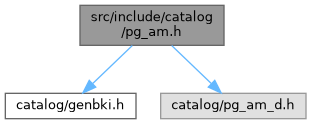
This graph shows which files directly or indirectly include this file:

Go to the source code of this file.
Functions | |
| BEGIN_CATALOG_STRUCT | CATALOG (pg_am, 2601, AccessMethodRelationId) |
| DECLARE_UNIQUE_INDEX (pg_am_name_index, 2651, AmNameIndexId, pg_am, btree(amname name_ops)) | |
| DECLARE_UNIQUE_INDEX_PKEY (pg_am_oid_index, 2652, AmOidIndexId, pg_am, btree(oid oid_ops)) | |
| MAKE_SYSCACHE (AMNAME, pg_am_name_index, 4) | |
| MAKE_SYSCACHE (AMOID, pg_am_oid_index, 4) | |
Variables | |
| END_CATALOG_STRUCT typedef FormData_pg_am * | Form_pg_am |
| FormData_pg_am | |
Function Documentation
◆ CATALOG()
| BEGIN_CATALOG_STRUCT CATALOG | ( | pg_am | , |
| 2601 | , | ||
| AccessMethodRelationId | |||
| ) |
Definition at line 31 of file pg_am.h.
32{
34
35 /* access method name */
36 NameData amname;
37
38 /* handler function */
40
41 /* see AMTYPE_xxx constants below */
42 char amtype;
43} FormData_pg_am;
References BKI_LOOKUP, and fb().
◆ DECLARE_UNIQUE_INDEX()
| DECLARE_UNIQUE_INDEX | ( | pg_am_name_index | , |
| 2651 | , | ||
| AmNameIndexId | , | ||
| pg_am | , | ||
| btree(amname name_ops) | |||
| ) |
◆ DECLARE_UNIQUE_INDEX_PKEY()
| DECLARE_UNIQUE_INDEX_PKEY | ( | pg_am_oid_index | , |
| 2652 | , | ||
| AmOidIndexId | , | ||
| pg_am | , | ||
| btree(oid oid_ops) | |||
| ) |
◆ MAKE_SYSCACHE() [1/2]
| MAKE_SYSCACHE | ( | AMNAME | , |
| pg_am_name_index | , | ||
| 4 | |||
| ) |
◆ MAKE_SYSCACHE() [2/2]
| MAKE_SYSCACHE | ( | AMOID | , |
| pg_am_oid_index | , | ||
| 4 | |||
| ) |
Variable Documentation
◆ Form_pg_am
| END_CATALOG_STRUCT typedef FormData_pg_am* Form_pg_am |
Definition at line 52 of file pg_am.h.
Referenced by AlterOpFamily(), CheckIndexCompatible(), DefineIndex(), DefineOpClass(), generateClonedIndexStmt(), get_am_name(), get_am_type_oid(), GetIndexAmRoutineByAmId(), getObjectDescription(), getObjectIdentityParts(), getOpFamilyDescription(), getOpFamilyIdentity(), OpClassCacheLookup(), OpFamilyCacheLookup(), pg_get_indexdef_worker(), RelationInitIndexAccessInfo(), and RelationInitTableAccessMethod().