Loading...
Searching...
No Matches
sasl.h File Reference
Include dependency graph for sasl.h:
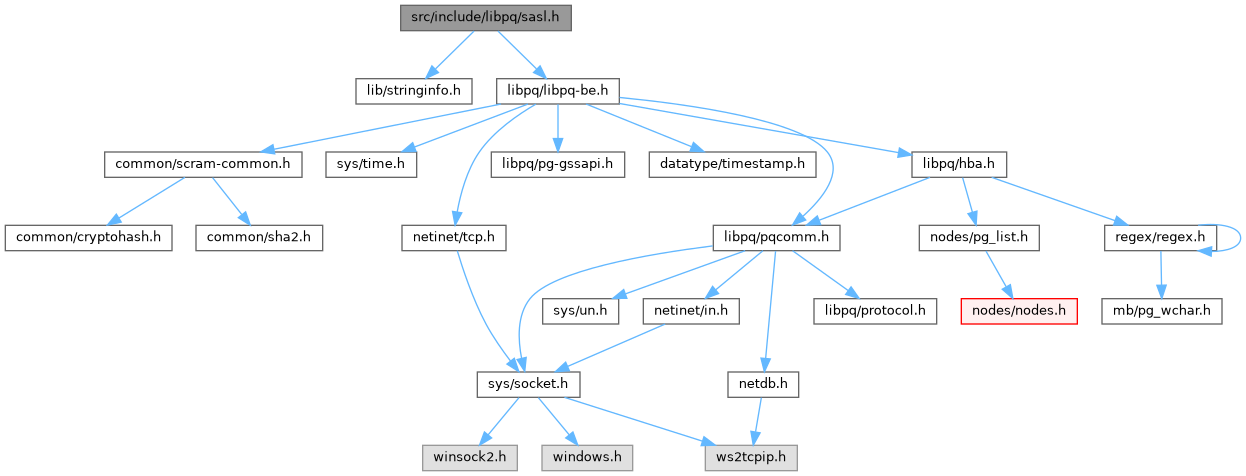
This graph shows which files directly or indirectly include this file:

Go to the source code of this file.
Data Structures | |
| struct | pg_be_sasl_mech |
Macros | |
| #define | PG_SASL_EXCHANGE_CONTINUE 0 |
| #define | PG_SASL_EXCHANGE_SUCCESS 1 |
| #define | PG_SASL_EXCHANGE_FAILURE 2 |
| #define | PG_SASL_EXCHANGE_ABANDONED 3 |
| #define | PG_MAX_SASL_MESSAGE_LENGTH 1024 |
Typedefs | |
| typedef struct pg_be_sasl_mech | pg_be_sasl_mech |
Functions | |
| int | CheckSASLAuth (const pg_be_sasl_mech *mech, Port *port, char *shadow_pass, const char **logdetail, bool *abandoned) |
Macro Definition Documentation
◆ PG_MAX_SASL_MESSAGE_LENGTH
◆ PG_SASL_EXCHANGE_ABANDONED
◆ PG_SASL_EXCHANGE_CONTINUE
◆ PG_SASL_EXCHANGE_FAILURE
◆ PG_SASL_EXCHANGE_SUCCESS
Typedef Documentation
◆ pg_be_sasl_mech
Function Documentation
◆ CheckSASLAuth()
|
extern |
Definition at line 50 of file auth-sasl.c.
52{
63
64 /*
65 * Send the SASL authentication request to user. It includes the list of
66 * authentication mechanisms that are supported.
67 */
69
71 /* Put another '\0' to mark that list is finished. */
73
76
77 /*
78 * Loop through SASL message exchange. This exchange can consist of
79 * multiple messages sent in both directions. First message is always
80 * from the client. All messages from client to server are password
81 * packets (type 'p').
82 */
84 do
85 {
86 pq_startmsgread();
89 {
90 /* Only log error if client didn't disconnect. */
92 {
96 mtype)));
97 }
98 else
100 }
101
102 /* Get the actual SASL message */
105 {
106 /* EOF - pq_getmessage already logged error */
109 }
110
112
113 /*
114 * The first SASLInitialResponse message is different from the others.
115 * It indicates which SASL mechanism the client selected, and contains
116 * an optional Initial Client Response payload. The subsequent
117 * SASLResponse messages contain just the SASL payload.
118 */
120 {
122
124
125 /*
126 * Initialize the status tracker for message exchanges.
127 *
128 * If the user doesn't exist, or doesn't have a valid password, or
129 * it's expired, we still go through the motions of SASL
130 * authentication, but tell the authentication method that the
131 * authentication is "doomed". That is, it's going to fail, no
132 * matter what.
133 *
134 * This is because we don't want to reveal to an attacker what
135 * usernames are valid, nor which users have a valid password.
136 */
138
142 else
144
146 }
147 else
148 {
151 }
153
154 /*
155 * The StringInfo guarantees that there's a \0 byte after the
156 * response.
157 */
159
160 /*
161 * Hand the incoming message to the mechanism implementation.
162 */
165 logdetail);
166
167 /* input buffer no longer used */
169
171 {
172 /*
173 * PG_SASL_EXCHANGE_FAILURE with some output is forbidden by SASL.
174 * Make sure here that the mechanism used got that right.
175 */
178
179 /*
180 * Negotiation generated data to be sent to the client.
181 */
183
186 else
188
190 }
192
194 {
196 {
197 /*
198 * Programmer error: caller needs to track the abandoned state for
199 * this mechanism.
200 */
202 }
203
205 }
206
207 /* Oops, Something bad happened */
209 {
211 }
212
214}
void sendAuthRequest(Port *port, AuthRequest areq, const void *extradata, int extralen)
Definition auth.c:684
FILE * input
Definition stringinfo.h:47
References appendStringInfoChar(), Assert, AUTH_REQ_SASL, AUTH_REQ_SASL_CONT, AUTH_REQ_SASL_FIN, buf, DEBUG4, elog, ereport, errcode(), ERRCODE_PROTOCOL_VIOLATION, errmsg, ERROR, fb(), initStringInfo(), input, output, pfree(), PG_SASL_EXCHANGE_ABANDONED, PG_SASL_EXCHANGE_CONTINUE, PG_SASL_EXCHANGE_FAILURE, PG_SASL_EXCHANGE_SUCCESS, port, pq_getbyte(), pq_getmessage(), pq_getmsgbytes(), pq_getmsgend(), pq_getmsgint(), pq_getmsgrawstring(), pq_startmsgread(), PqMsg_SASLResponse, result, sendAuthRequest(), STATUS_EOF, STATUS_ERROR, and STATUS_OK.
Referenced by CheckPWChallengeAuth(), and ClientAuthentication().