PostgreSQL Source Code git master
Loading...
Searching...
No Matches
pg_aggregate.h File Reference
#include "catalog/genbki.h"
#include "catalog/pg_aggregate_d.h"
#include "catalog/objectaddress.h"
#include "nodes/pg_list.h"
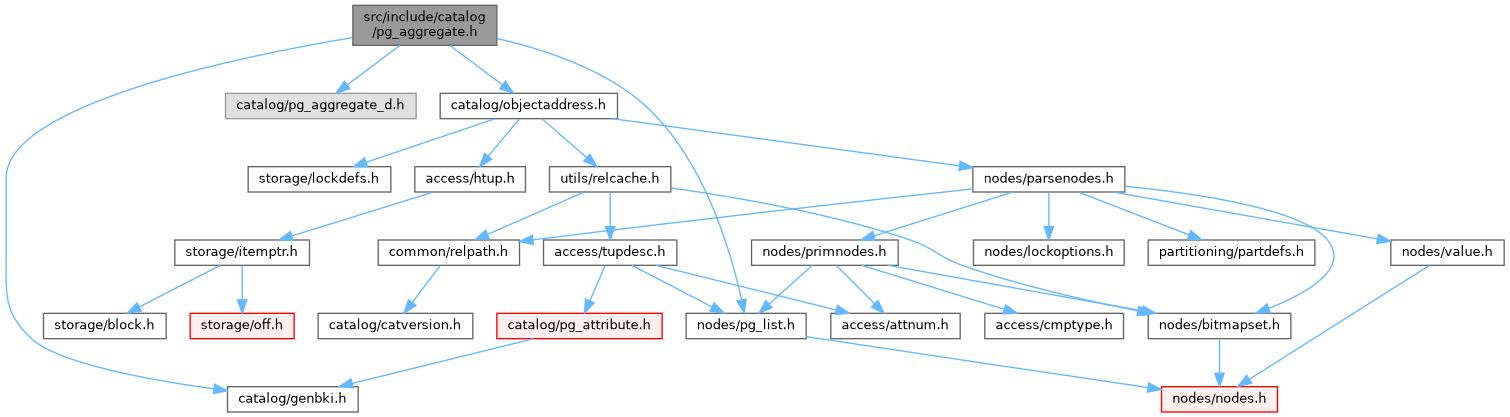
Include dependency graph for pg_aggregate.h:
This graph shows which files directly or indirectly include this file:

Go to the source code of this file.

Typedefs

typedef FormData_pg_aggregateForm_pg_aggregate
 

Functions

 CATALOG (pg_aggregate, 2600, AggregateRelationId)
 
 DECLARE_TOAST (pg_aggregate, 4159, 4160)
 
 DECLARE_UNIQUE_INDEX_PKEY (pg_aggregate_fnoid_index, 2650, AggregateFnoidIndexId, pg_aggregate, btree(aggfnoid oid_ops))
 
 MAKE_SYSCACHE (AGGFNOID, pg_aggregate_fnoid_index, 16)
 
ObjectAddress AggregateCreate (const char *aggName, Oid aggNamespace, bool replace, char aggKind, int numArgs, int numDirectArgs, oidvector *parameterTypes, Datum allParameterTypes, Datum parameterModes, Datum parameterNames, List *parameterDefaults, Oid variadicArgType, List *aggtransfnName, List *aggfinalfnName, List *aggcombinefnName, List *aggserialfnName, List *aggdeserialfnName, List *aggmtransfnName, List *aggminvtransfnName, List *aggmfinalfnName, bool finalfnExtraArgs, bool mfinalfnExtraArgs, char finalfnModify, char mfinalfnModify, List *aggsortopName, Oid aggTransType, int32 aggTransSpace, Oid aggmTransType, int32 aggmTransSpace, const char *agginitval, const char *aggminitval, char proparallel)
 

Variables

 FormData_pg_aggregate
 

Typedef Documentation

◆ Form_pg_aggregate

Function Documentation

◆ AggregateCreate()

ObjectAddress AggregateCreate ( const char aggName,
Oid  aggNamespace,
bool  replace,
char  aggKind,
int  numArgs,
int  numDirectArgs,
oidvector parameterTypes,
Datum  allParameterTypes,
Datum  parameterModes,
Datum  parameterNames,
List parameterDefaults,
Oid  variadicArgType,
List aggtransfnName,
List aggfinalfnName,
List aggcombinefnName,
List aggserialfnName,
List aggdeserialfnName,
List aggmtransfnName,
List aggminvtransfnName,
List aggmfinalfnName,
bool  finalfnExtraArgs,
bool  mfinalfnExtraArgs,
char  finalfnModify,
char  mfinalfnModify,
List aggsortopName,
Oid  aggTransType,
int32  aggTransSpace,
Oid  aggmTransType,
int32  aggmTransSpace,
const char agginitval,
const char aggminitval,
char  proparallel 
)
extern

Definition at line 46 of file pg_aggregate.c.

78{
82 bool nulls[Natts_pg_aggregate];
85 Form_pg_proc proc;
86 Oid transfn;
87 Oid finalfn = InvalidOid; /* can be omitted */
88 Oid combinefn = InvalidOid; /* can be omitted */
89 Oid serialfn = InvalidOid; /* can be omitted */
90 Oid deserialfn = InvalidOid; /* can be omitted */
91 Oid mtransfn = InvalidOid; /* can be omitted */
92 Oid minvtransfn = InvalidOid; /* can be omitted */
93 Oid mfinalfn = InvalidOid; /* can be omitted */
94 Oid sortop = InvalidOid; /* can be omitted */
95 Oid *aggArgTypes = parameterTypes->values;
96 bool mtransIsStrict = false;
97 Oid rettype;
100 int nargs_transfn;
101 int nargs_finalfn;
102 Oid procOid;
103 TupleDesc tupDesc;
104 char *detailmsg;
105 int i;
108 ObjectAddresses *addrs;
110
111 /* sanity checks (caller should have caught these) */
112 if (!aggName)
113 elog(ERROR, "no aggregate name supplied");
114
115 if (!aggtransfnName)
116 elog(ERROR, "aggregate must have a transition function");
117
119 elog(ERROR, "incorrect number of direct arguments for aggregate");
120
121 /*
122 * Aggregates can have at most FUNC_MAX_ARGS-1 args, else the transfn
123 * and/or finalfn will be unrepresentable in pg_proc. We must check now
124 * to protect fixed-size arrays here and possibly in called functions.
125 */
129 errmsg_plural("aggregates cannot have more than %d argument",
130 "aggregates cannot have more than %d arguments",
131 FUNC_MAX_ARGS - 1,
132 FUNC_MAX_ARGS - 1)));
133
134 /*
135 * If transtype is polymorphic, must have polymorphic argument also; else
136 * we will have no way to deduce the actual transtype.
137 */
140 numArgs);
141 if (detailmsg)
144 errmsg("cannot determine transition data type"),
145 errdetail_internal("%s", detailmsg)));
146
147 /*
148 * Likewise for moving-aggregate transtype, if any
149 */
151 {
154 numArgs);
155 if (detailmsg)
158 errmsg("cannot determine transition data type"),
159 errdetail_internal("%s", detailmsg)));
160 }
161
162 /*
163 * An ordered-set aggregate that is VARIADIC must be VARIADIC ANY. In
164 * principle we could support regular variadic types, but it would make
165 * things much more complicated because we'd have to assemble the correct
166 * subsets of arguments into array values. Since no standard aggregates
167 * have use for such a case, we aren't bothering for now.
168 */
173 errmsg("a variadic ordered-set aggregate must use VARIADIC type ANY")));
174
175 /*
176 * If it's a hypothetical-set aggregate, there must be at least as many
177 * direct arguments as aggregated ones, and the last N direct arguments
178 * must match the aggregated ones in type. (We have to check this again
179 * when the aggregate is called, in case ANY is involved, but it makes
180 * sense to reject the aggregate definition now if the declared arg types
181 * don't match up.) It's unconditionally OK if numDirectArgs == numArgs,
182 * indicating that the grammar merged identical VARIADIC entries from both
183 * lists. Otherwise, if the agg is VARIADIC, then we had VARIADIC only on
184 * the aggregated side, which is not OK. Otherwise, insist on the last N
185 * parameter types on each side matching exactly.
186 */
189 {
191
196 numAggregatedArgs * sizeof(Oid)) != 0)
199 errmsg("a hypothetical-set aggregate must have direct arguments matching its aggregated arguments")));
200 }
201
202 /*
203 * Find the transfn. For ordinary aggs, it takes the transtype plus all
204 * aggregate arguments. For ordered-set aggs, it takes the transtype plus
205 * all aggregated args, but not direct args. However, we have to treat
206 * specially the case where a trailing VARIADIC item is considered to
207 * cover both direct and aggregated args.
208 */
210 {
213 else
214 {
215 /* special case with VARIADIC last arg */
217 nargs_transfn = 2;
218 }
219 fnArgs[0] = aggTransType;
221 (nargs_transfn - 1) * sizeof(Oid));
222 }
223 else
224 {
226 fnArgs[0] = aggTransType;
227 memcpy(fnArgs + 1, aggArgTypes, numArgs * sizeof(Oid));
228 }
231 &rettype);
232
233 /*
234 * Return type of transfn (possibly after refinement by
235 * enforce_generic_type_consistency, if transtype isn't polymorphic) must
236 * exactly match declared transtype.
237 *
238 * In the non-polymorphic-transtype case, it might be okay to allow a
239 * rettype that's binary-coercible to transtype, but I'm not quite
240 * convinced that it's either safe or useful. When transtype is
241 * polymorphic we *must* demand exact equality.
242 */
243 if (rettype != aggTransType)
246 errmsg("return type of transition function %s is not %s",
249
251 if (!HeapTupleIsValid(tup))
252 elog(ERROR, "cache lookup failed for function %u", transfn);
253 proc = (Form_pg_proc) GETSTRUCT(tup);
254
255 /*
256 * If the transfn is strict and the initval is NULL, make sure first input
257 * type and transtype are the same (or at least binary-compatible), so
258 * that it's OK to use the first input value as the initial transValue.
259 */
260 if (proc->proisstrict && agginitval == NULL)
261 {
262 if (numArgs < 1 ||
266 errmsg("must not omit initial value when transition function is strict and transition type is not compatible with input type")));
267 }
268
270
271 /* handle moving-aggregate transfn, if supplied */
272 if (aggmtransfnName)
273 {
274 /*
275 * The arguments are the same as for the regular transfn, except that
276 * the transition data type might be different. So re-use the fnArgs
277 * values set up above, except for that one.
278 */
281
284 &rettype);
285
286 /* As above, return type must exactly match declared mtranstype. */
287 if (rettype != aggmTransType)
290 errmsg("return type of transition function %s is not %s",
293
295 if (!HeapTupleIsValid(tup))
296 elog(ERROR, "cache lookup failed for function %u", mtransfn);
297 proc = (Form_pg_proc) GETSTRUCT(tup);
298
299 /*
300 * If the mtransfn is strict and the minitval is NULL, check first
301 * input type and mtranstype are binary-compatible.
302 */
303 if (proc->proisstrict && aggminitval == NULL)
304 {
305 if (numArgs < 1 ||
309 errmsg("must not omit initial value when transition function is strict and transition type is not compatible with input type")));
310 }
311
312 /* Remember if mtransfn is strict; we may need this below */
313 mtransIsStrict = proc->proisstrict;
314
316 }
317
318 /* handle minvtransfn, if supplied */
320 {
321 /*
322 * This must have the same number of arguments with the same types as
323 * the forward transition function, so just re-use the fnArgs data.
324 */
326
329 &rettype);
330
331 /* As above, return type must exactly match declared mtranstype. */
332 if (rettype != aggmTransType)
335 errmsg("return type of inverse transition function %s is not %s",
338
340 if (!HeapTupleIsValid(tup))
341 elog(ERROR, "cache lookup failed for function %u", minvtransfn);
342 proc = (Form_pg_proc) GETSTRUCT(tup);
343
344 /*
345 * We require the strictness settings of the forward and inverse
346 * transition functions to agree. This saves having to handle
347 * assorted special cases at execution time.
348 */
349 if (proc->proisstrict != mtransIsStrict)
352 errmsg("strictness of aggregate's forward and inverse transition functions must match")));
353
355 }
356
357 /* handle finalfn, if supplied */
358 if (aggfinalfnName)
359 {
360 /*
361 * If finalfnExtraArgs is specified, the transfn takes the transtype
362 * plus all args; otherwise, it just takes the transtype plus any
363 * direct args. (Non-direct args are useless at runtime, and are
364 * actually passed as NULLs, but we may need them in the function
365 * signature to allow resolution of a polymorphic agg's result type.)
366 */
368
369 fnArgs[0] = aggTransType;
370 memcpy(fnArgs + 1, aggArgTypes, numArgs * sizeof(Oid));
373 else
374 {
377 {
378 /* variadic argument doesn't affect finalfn */
380 }
381 }
382
385 &finaltype);
386
387 /*
388 * When finalfnExtraArgs is specified, the finalfn will certainly be
389 * passed at least one null argument, so complain if it's strict.
390 * Nothing bad would happen at runtime (you'd just get a null result),
391 * but it's surely not what the user wants, so let's complain now.
392 */
393 if (finalfnExtraArgs && func_strict(finalfn))
396 errmsg("final function with extra arguments must not be declared STRICT")));
397 }
398 else
399 {
400 /*
401 * If no finalfn, aggregate result type is type of the state value
402 */
404 }
406
407 /* handle the combinefn, if supplied */
409 {
411
412 /*
413 * Combine function must have 2 arguments, each of which is the trans
414 * type. VARIADIC doesn't affect it.
415 */
416 fnArgs[0] = aggTransType;
417 fnArgs[1] = aggTransType;
418
421 &combineType);
422
423 /* Ensure the return type matches the aggregate's trans type */
427 errmsg("return type of combine function %s is not %s",
430
431 /*
432 * A combine function to combine INTERNAL states must accept nulls and
433 * ensure that the returned state is in the correct memory context. We
434 * cannot directly check the latter, but we can check the former.
435 */
439 errmsg("combine function with transition type %s must not be declared STRICT",
441 }
442
443 /*
444 * Validate the serialization function, if present.
445 */
446 if (aggserialfnName)
447 {
448 /* signature is always serialize(internal) returns bytea */
449 fnArgs[0] = INTERNALOID;
450
453 &rettype);
454
455 if (rettype != BYTEAOID)
458 errmsg("return type of serialization function %s is not %s",
461 }
462
463 /*
464 * Validate the deserialization function, if present.
465 */
467 {
468 /* signature is always deserialize(bytea, internal) returns internal */
469 fnArgs[0] = BYTEAOID;
470 fnArgs[1] = INTERNALOID; /* dummy argument for type safety */
471
474 &rettype);
475
476 if (rettype != INTERNALOID)
479 errmsg("return type of deserialization function %s is not %s",
482 }
483
484 /*
485 * If finaltype (i.e. aggregate return type) is polymorphic, inputs must
486 * be polymorphic also, else parser will fail to deduce result type.
487 * (Note: given the previous test on transtype and inputs, this cannot
488 * happen, unless someone has snuck a finalfn definition into the catalogs
489 * that itself violates the rule against polymorphic result with no
490 * polymorphic input.)
491 */
494 numArgs);
495 if (detailmsg)
498 errmsg("cannot determine result data type"),
499 errdetail_internal("%s", detailmsg)));
500
501 /*
502 * Also, the return type can't be INTERNAL unless there's at least one
503 * INTERNAL argument. This is the same type-safety restriction we enforce
504 * for regular functions, but at the level of aggregates. We must test
505 * this explicitly because we allow INTERNAL as the transtype.
506 */
509 numArgs);
510 if (detailmsg)
513 errmsg("unsafe use of pseudo-type \"internal\""),
514 errdetail_internal("%s", detailmsg)));
515
516 /*
517 * If a moving-aggregate implementation is supplied, look up its finalfn
518 * if any, and check that the implied aggregate result type matches the
519 * plain implementation.
520 */
522 {
523 /* handle finalfn, if supplied */
524 if (aggmfinalfnName)
525 {
526 /*
527 * The arguments are figured the same way as for the regular
528 * finalfn, but using aggmTransType and mfinalfnExtraArgs.
529 */
531
533 memcpy(fnArgs + 1, aggArgTypes, numArgs * sizeof(Oid));
536 else
537 {
540 {
541 /* variadic argument doesn't affect finalfn */
543 }
544 }
545
548 &rettype);
549
550 /* As above, check strictness if mfinalfnExtraArgs is given */
554 errmsg("final function with extra arguments must not be declared STRICT")));
555 }
556 else
557 {
558 /*
559 * If no finalfn, aggregate result type is type of the state value
560 */
561 rettype = aggmTransType;
562 }
563 Assert(OidIsValid(rettype));
564 if (rettype != finaltype)
567 errmsg("moving-aggregate implementation returns type %s, but plain implementation returns type %s",
568 format_type_be(rettype),
570 }
571
572 /* handle sortop, if supplied */
573 if (aggsortopName)
574 {
575 if (numArgs != 1)
578 errmsg("sort operator can only be specified for single-argument aggregates")));
581 false, -1);
582 }
583
584 /*
585 * permission checks on used types
586 */
587 for (i = 0; i < numArgs; i++)
588 {
590 if (aclresult != ACLCHECK_OK)
592 }
593
595 if (aclresult != ACLCHECK_OK)
597
599 {
601 if (aclresult != ACLCHECK_OK)
603 }
604
606 if (aclresult != ACLCHECK_OK)
608
609
610 /*
611 * Everything looks okay. Try to create the pg_proc entry for the
612 * aggregate. (This could fail if there's already a conflicting entry.)
613 */
614
617 replace, /* maybe replacement */
618 false, /* doesn't return a set */
619 finaltype, /* returnType */
620 GetUserId(), /* proowner */
621 INTERNALlanguageId, /* languageObjectId */
622 InvalidOid, /* no validator */
623 "aggregate_dummy", /* placeholder (no such proc) */
624 NULL, /* probin */
625 NULL, /* prosqlbody */
627 false, /* security invoker (currently not
628 * definable for agg) */
629 false, /* isLeakProof */
630 false, /* isStrict (not needed for agg) */
631 PROVOLATILE_IMMUTABLE, /* volatility (not needed
632 * for agg) */
634 parameterTypes, /* paramTypes */
635 allParameterTypes, /* allParamTypes */
636 parameterModes, /* parameterModes */
637 parameterNames, /* parameterNames */
638 parameterDefaults, /* parameterDefaults */
639 PointerGetDatum(NULL), /* trftypes */
640 NIL, /* trfoids */
641 PointerGetDatum(NULL), /* proconfig */
642 InvalidOid, /* no prosupport */
643 1, /* procost */
644 0); /* prorows */
645 procOid = myself.objectId;
646
647 /*
648 * Okay to create the pg_aggregate entry.
649 */
651 tupDesc = aggdesc->rd_att;
652
653 /* initialize nulls and values */
654 for (i = 0; i < Natts_pg_aggregate; i++)
655 {
656 nulls[i] = false;
657 values[i] = (Datum) 0;
658 replaces[i] = true;
659 }
680 if (agginitval)
682 else
683 nulls[Anum_pg_aggregate_agginitval - 1] = true;
684 if (aggminitval)
686 else
687 nulls[Anum_pg_aggregate_aggminitval - 1] = true;
688
689 if (replace)
691 else
692 oldtup = NULL;
693
695 {
697
698 /*
699 * If we're replacing an existing entry, we need to validate that
700 * we're not changing anything that would break callers. Specifically
701 * we must not change aggkind or aggnumdirectargs, which affect how an
702 * aggregate call is treated in parse analysis.
703 */
704 if (aggKind != oldagg->aggkind)
707 errmsg("cannot change routine kind"),
708 (oldagg->aggkind == AGGKIND_NORMAL ?
709 errdetail("\"%s\" is an ordinary aggregate function.", aggName) :
711 errdetail("\"%s\" is an ordered-set aggregate.", aggName) :
713 errdetail("\"%s\" is a hypothetical-set aggregate.", aggName) :
714 0)));
715 if (numDirectArgs != oldagg->aggnumdirectargs)
718 errmsg("cannot change number of direct arguments of an aggregate function")));
719
723
724 tup = heap_modify_tuple(oldtup, tupDesc, values, nulls, replaces);
725 CatalogTupleUpdate(aggdesc, &tup->t_self, tup);
727 }
728 else
729 {
730 tup = heap_form_tuple(tupDesc, values, nulls);
732 }
733
735
736 /*
737 * Create dependencies for the aggregate (above and beyond those already
738 * made by ProcedureCreate). Note: we don't need an explicit dependency
739 * on aggTransType since we depend on it indirectly through transfn.
740 * Likewise for aggmTransType using the mtransfn, if it exists.
741 *
742 * If we're replacing an existing definition, ProcedureCreate deleted all
743 * our existing dependencies, so we have to do the same things here either
744 * way.
745 */
746
747 addrs = new_object_addresses();
748
749 /* Depends on transition function */
752
753 /* Depends on final function, if any */
754 if (OidIsValid(finalfn))
755 {
758 }
759
760 /* Depends on combine function, if any */
762 {
765 }
766
767 /* Depends on serialization function, if any */
768 if (OidIsValid(serialfn))
769 {
772 }
773
774 /* Depends on deserialization function, if any */
775 if (OidIsValid(deserialfn))
776 {
779 }
780
781 /* Depends on forward transition function, if any */
782 if (OidIsValid(mtransfn))
783 {
786 }
787
788 /* Depends on inverse transition function, if any */
790 {
793 }
794
795 /* Depends on final function, if any */
796 if (OidIsValid(mfinalfn))
797 {
800 }
801
802 /* Depends on sort operator, if any */
803 if (OidIsValid(sortop))
804 {
807 }
808
811 return myself;
812}
AclResult
Definition acl.h:182
@ ACLCHECK_OK
Definition acl.h:183
AclResult object_aclcheck(Oid classid, Oid objectid, Oid roleid, AclMode mode)
Definition aclchk.c:3836
void aclcheck_error_type(AclResult aclerr, Oid typeOid)
Definition aclchk.c:2973
static Datum values[MAXATTR]
Definition bootstrap.c:155
#define CStringGetTextDatum(s)
Definition builtins.h:97
#define Assert(condition)
Definition c.h:873
#define OidIsValid(objectId)
Definition c.h:788
void record_object_address_dependencies(const ObjectAddress *depender, ObjectAddresses *referenced, DependencyType behavior)
void add_exact_object_address(const ObjectAddress *object, ObjectAddresses *addrs)
ObjectAddresses * new_object_addresses(void)
void free_object_addresses(ObjectAddresses *addrs)
@ DEPENDENCY_NORMAL
Definition dependency.h:33
int errmsg_plural(const char *fmt_singular, const char *fmt_plural, unsigned long n,...)
Definition elog.c:1193
int errdetail_internal(const char *fmt,...)
Definition elog.c:1243
int errdetail(const char *fmt,...)
Definition elog.c:1216
int errcode(int sqlerrcode)
Definition elog.c:863
int errmsg(const char *fmt,...)
Definition elog.c:1080
#define ERROR
Definition elog.h:39
#define elog(elevel,...)
Definition elog.h:226
#define ereport(elevel,...)
Definition elog.h:150
char * format_type_be(Oid type_oid)
HeapTuple heap_modify_tuple(HeapTuple tuple, TupleDesc tupleDesc, const Datum *replValues, const bool *replIsnull, const bool *doReplace)
Definition heaptuple.c:1210
HeapTuple heap_form_tuple(TupleDesc tupleDescriptor, const Datum *values, const bool *isnull)
Definition heaptuple.c:1117
#define HeapTupleIsValid(tuple)
Definition htup.h:78
static void * GETSTRUCT(const HeapTupleData *tuple)
void CatalogTupleUpdate(Relation heapRel, const ItemPointerData *otid, HeapTuple tup)
Definition indexing.c:313
void CatalogTupleInsert(Relation heapRel, HeapTuple tup)
Definition indexing.c:233
int i
Definition isn.c:77
#define RowExclusiveLock
Definition lockdefs.h:38
bool func_strict(Oid funcid)
Definition lsyscache.c:1911
Oid GetUserId(void)
Definition miscinit.c:469
char * NameListToString(const List *names)
Definition namespace.c:3664
#define ObjectAddressSet(addr, class_id, object_id)
char * check_valid_internal_signature(Oid ret_type, const Oid *declared_arg_types, int nargs)
char * check_valid_polymorphic_signature(Oid ret_type, const Oid *declared_arg_types, int nargs)
bool IsBinaryCoercible(Oid srctype, Oid targettype)
Oid LookupOperName(ParseState *pstate, List *opername, Oid oprleft, Oid oprright, bool noError, int location)
Definition parse_oper.c:100
#define ACL_USAGE
Definition parsenodes.h:84
static Oid lookup_agg_function(List *fnName, int nargs, Oid *input_types, Oid variadicArgType, Oid *rettype)
FormData_pg_aggregate * Form_pg_aggregate
#define FUNC_MAX_ARGS
#define NIL
Definition pg_list.h:68
ObjectAddress ProcedureCreate(const char *procedureName, Oid procNamespace, bool replace, bool returnsSet, Oid returnType, Oid proowner, Oid languageObjectId, Oid languageValidator, const char *prosrc, const char *probin, Node *prosqlbody, char prokind, bool security_definer, bool isLeakProof, bool isStrict, char volatility, char parallel, oidvector *parameterTypes, Datum allParameterTypes, Datum parameterModes, Datum parameterNames, List *parameterDefaults, Datum trftypes, List *trfoids, Datum proconfig, Oid prosupport, float4 procost, float4 prorows)
Definition pg_proc.c:99
FormData_pg_proc * Form_pg_proc
Definition pg_proc.h:136
static Datum PointerGetDatum(const void *X)
Definition postgres.h:352
static Datum Int16GetDatum(int16 X)
Definition postgres.h:182
static Datum BoolGetDatum(bool X)
Definition postgres.h:112
static Datum ObjectIdGetDatum(Oid X)
Definition postgres.h:262
uint64_t Datum
Definition postgres.h:70
static Datum Int32GetDatum(int32 X)
Definition postgres.h:222
static Datum CharGetDatum(char X)
Definition postgres.h:132
#define InvalidOid
unsigned int Oid
static int fb(int x)
Oid values[FLEXIBLE_ARRAY_MEMBER]
Definition c.h:752
void ReleaseSysCache(HeapTuple tuple)
Definition syscache.c:264
HeapTuple SearchSysCache1(int cacheId, Datum key1)
Definition syscache.c:220
void table_close(Relation relation, LOCKMODE lockmode)
Definition table.c:126
Relation table_open(Oid relationId, LOCKMODE lockmode)
Definition table.c:40

References ACL_USAGE, aclcheck_error_type(), ACLCHECK_OK, add_exact_object_address(), Assert, BoolGetDatum(), CatalogTupleInsert(), CatalogTupleUpdate(), CharGetDatum(), check_valid_internal_signature(), check_valid_polymorphic_signature(), CStringGetTextDatum, DEPENDENCY_NORMAL, elog, ereport, errcode(), errdetail(), errdetail_internal(), errmsg(), errmsg_plural(), ERROR, fb(), format_type_be(), free_object_addresses(), FUNC_MAX_ARGS, func_strict(), GETSTRUCT(), GetUserId(), heap_form_tuple(), heap_modify_tuple(), HeapTupleIsValid, i, Int16GetDatum(), Int32GetDatum(), InvalidOid, IsBinaryCoercible(), lookup_agg_function(), LookupOperName(), NameListToString(), new_object_addresses(), NIL, object_aclcheck(), ObjectAddressSet, ObjectIdGetDatum(), OidIsValid, PointerGetDatum(), ProcedureCreate(), record_object_address_dependencies(), ReleaseSysCache(), RowExclusiveLock, SearchSysCache1(), table_close(), table_open(), oidvector::values, and values.

Referenced by DefineAggregate().

◆ CATALOG()

CATALOG ( pg_aggregate  ,
2600  ,
AggregateRelationId   
)

Definition at line 32 of file pg_aggregate.h.

33{
34 /* pg_proc OID of the aggregate itself */
35 regproc aggfnoid BKI_LOOKUP(pg_proc);
36
37 /* aggregate kind, see AGGKIND_ categories below */
38 char aggkind BKI_DEFAULT(n);
39
40 /* number of arguments that are "direct" arguments */
42
43 /* transition function */
45
46 /* final function (0 if none) */
48
49 /* combine function (0 if none) */
51
52 /* function to convert transtype to bytea (0 if none) */
54
55 /* function to convert bytea to transtype (0 if none) */
57
58 /* forward function for moving-aggregate mode (0 if none) */
60
61 /* inverse function for moving-aggregate mode (0 if none) */
63
64 /* final function for moving-aggregate mode (0 if none) */
66
67 /* true to pass extra dummy arguments to aggfinalfn */
69
70 /* true to pass extra dummy arguments to aggmfinalfn */
72
73 /* tells whether aggfinalfn modifies transition state */
75
76 /* tells whether aggmfinalfn modifies transition state */
78
79 /* associated sort operator (0 if none) */
81
82 /* type of aggregate's transition (state) data */
83 Oid aggtranstype BKI_LOOKUP(pg_type);
84
85 /* estimated size of state data (0 for default estimate) */
86 int32 aggtransspace BKI_DEFAULT(0);
87
88 /* type of moving-aggregate state data (0 if none) */
90
91 /* estimated size of moving-agg state (0 for default est) */
93
94#ifdef CATALOG_VARLEN /* variable-length fields start here */
95
96 /* initial value for transition state (can be NULL) */
98
99 /* initial value for moving-agg state (can be NULL) */
101#endif
Oid regproc
Definition c.h:663
int16_t int16
Definition c.h:541
int32_t int32
Definition c.h:542
#define BKI_LOOKUP(catalog)
Definition genbki.h:46
#define BKI_DEFAULT(value)
Definition genbki.h:35
#define BKI_LOOKUP_OPT(catalog)
Definition genbki.h:47
FormData_pg_aggregate
Definition c.h:706

References BKI_DEFAULT, BKI_LOOKUP, BKI_LOOKUP_OPT, and fb().

◆ DECLARE_TOAST()

DECLARE_TOAST ( pg_aggregate  ,
4159  ,
4160   
)

◆ DECLARE_UNIQUE_INDEX_PKEY()

DECLARE_UNIQUE_INDEX_PKEY ( pg_aggregate_fnoid_index  ,
2650  ,
AggregateFnoidIndexId  ,
pg_aggregate  ,
btree(aggfnoid oid_ops  
)

◆ MAKE_SYSCACHE()

MAKE_SYSCACHE ( AGGFNOID  ,
pg_aggregate_fnoid_index  ,
16   
)

Variable Documentation

◆ FormData_pg_aggregate

FormData_pg_aggregate

Definition at line 102 of file pg_aggregate.h.