PostgreSQL Source Code git master
Loading...
Searching...
No Matches
parse_coerce.h File Reference
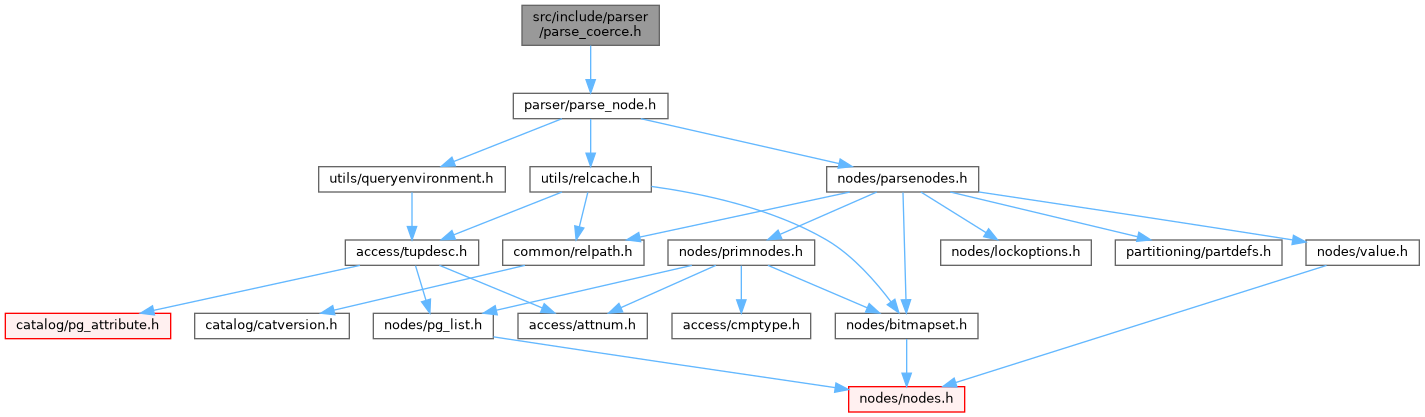
Include dependency graph for parse_coerce.h:
This graph shows which files directly or indirectly include this file:

Go to the source code of this file.

Typedefs

typedef char TYPCATEGORY
 
typedef enum CoercionPathType CoercionPathType
 

Enumerations

enum  CoercionPathType {
  COERCION_PATH_NONE , COERCION_PATH_FUNC , COERCION_PATH_RELABELTYPE , COERCION_PATH_ARRAYCOERCE ,
  COERCION_PATH_COERCEVIAIO
}
 

Functions

bool IsBinaryCoercible (Oid srctype, Oid targettype)
 
bool IsBinaryCoercibleWithCast (Oid srctype, Oid targettype, Oid *castoid)
 
bool IsPreferredType (TYPCATEGORY category, Oid type)
 
TYPCATEGORY TypeCategory (Oid type)
 
Nodecoerce_to_target_type (ParseState *pstate, Node *expr, Oid exprtype, Oid targettype, int32 targettypmod, CoercionContext ccontext, CoercionForm cformat, int location)
 
bool can_coerce_type (int nargs, const Oid *input_typeids, const Oid *target_typeids, CoercionContext ccontext)
 
Nodecoerce_type (ParseState *pstate, Node *node, Oid inputTypeId, Oid targetTypeId, int32 targetTypeMod, CoercionContext ccontext, CoercionForm cformat, int location)
 
Nodecoerce_to_domain (Node *arg, Oid baseTypeId, int32 baseTypeMod, Oid typeId, CoercionContext ccontext, CoercionForm cformat, int location, bool hideInputCoercion)
 
Nodecoerce_to_boolean (ParseState *pstate, Node *node, const char *constructName)
 
Nodecoerce_to_specific_type (ParseState *pstate, Node *node, Oid targetTypeId, const char *constructName)
 
Nodecoerce_to_specific_type_typmod (ParseState *pstate, Node *node, Oid targetTypeId, int32 targetTypmod, const char *constructName)
 
Nodecoerce_null_to_domain (Oid typid, int32 typmod, Oid collation, int typlen, bool typbyval)
 
int parser_coercion_errposition (ParseState *pstate, int coerce_location, Node *input_expr)
 
Oid select_common_type (ParseState *pstate, List *exprs, const char *context, Node **which_expr)
 
Nodecoerce_to_common_type (ParseState *pstate, Node *node, Oid targetTypeId, const char *context)
 
bool verify_common_type (Oid common_type, List *exprs)
 
int32 select_common_typmod (ParseState *pstate, List *exprs, Oid common_type)
 
bool check_generic_type_consistency (const Oid *actual_arg_types, const Oid *declared_arg_types, int nargs)
 
Oid enforce_generic_type_consistency (const Oid *actual_arg_types, Oid *declared_arg_types, int nargs, Oid rettype, bool allow_poly)
 
charcheck_valid_polymorphic_signature (Oid ret_type, const Oid *declared_arg_types, int nargs)
 
charcheck_valid_internal_signature (Oid ret_type, const Oid *declared_arg_types, int nargs)
 
CoercionPathType find_coercion_pathway (Oid targetTypeId, Oid sourceTypeId, CoercionContext ccontext, Oid *funcid)
 
CoercionPathType find_typmod_coercion_function (Oid typeId, Oid *funcid)
 

Typedef Documentation

◆ CoercionPathType

◆ TYPCATEGORY

Definition at line 21 of file parse_coerce.h.

Enumeration Type Documentation

◆ CoercionPathType

Enumerator
COERCION_PATH_NONE 
COERCION_PATH_FUNC 
COERCION_PATH_RELABELTYPE 
COERCION_PATH_ARRAYCOERCE 
COERCION_PATH_COERCEVIAIO 

Definition at line 24 of file parse_coerce.h.

25{
26 COERCION_PATH_NONE, /* failed to find any coercion pathway */
27 COERCION_PATH_FUNC, /* apply the specified coercion function */
28 COERCION_PATH_RELABELTYPE, /* binary-compatible cast, no function */
29 COERCION_PATH_ARRAYCOERCE, /* need an ArrayCoerceExpr node */
30 COERCION_PATH_COERCEVIAIO, /* need a CoerceViaIO node */
CoercionPathType
@ COERCION_PATH_NONE
@ COERCION_PATH_COERCEVIAIO
@ COERCION_PATH_ARRAYCOERCE
@ COERCION_PATH_FUNC
@ COERCION_PATH_RELABELTYPE

Function Documentation

◆ can_coerce_type()

bool can_coerce_type ( int  nargs,
const Oid input_typeids,
const Oid target_typeids,
CoercionContext  ccontext 
)
extern

Definition at line 558 of file parse_coerce.c.

560{
561 bool have_generics = false;
562 int i;
563
564 /* run through argument list... */
565 for (i = 0; i < nargs; i++)
566 {
569 CoercionPathType pathtype;
570 Oid funcId;
571
572 /* no problem if same type */
574 continue;
575
576 /* accept if target is ANY */
577 if (targetTypeId == ANYOID)
578 continue;
579
580 /* accept if target is polymorphic, for now */
582 {
583 have_generics = true; /* do more checking later */
584 continue;
585 }
586
587 /*
588 * If input is an untyped string constant, assume we can convert it to
589 * anything.
590 */
591 if (inputTypeId == UNKNOWNOID)
592 continue;
593
594 /*
595 * If pg_cast shows that we can coerce, accept. This test now covers
596 * both binary-compatible and coercion-function cases.
597 */
599 &funcId);
600 if (pathtype != COERCION_PATH_NONE)
601 continue;
602
603 /*
604 * If input is RECORD and target is a composite type, assume we can
605 * coerce (may need tighter checking here)
606 */
607 if (inputTypeId == RECORDOID &&
609 continue;
610
611 /*
612 * If input is a composite type and target is RECORD, accept
613 */
614 if (targetTypeId == RECORDOID &&
616 continue;
617
618#ifdef NOT_USED /* not implemented yet */
619
620 /*
621 * If input is record[] and target is a composite array type, assume
622 * we can coerce (may need tighter checking here)
623 */
626 continue;
627#endif
628
629 /*
630 * If input is a composite array type and target is record[], accept
631 */
634 continue;
635
636 /*
637 * If input is a class type that inherits from target, accept
638 */
641 continue;
642
643 /*
644 * Else, cannot coerce at this argument position
645 */
646 return false;
647 }
648
649 /* If we found any generic argument types, cross-check them */
650 if (have_generics)
651 {
653 nargs))
654 return false;
655 }
656
657 return true;
658}
int i
Definition isn.c:77
static bool typeIsOfTypedTable(Oid reltypeId, Oid reloftypeId)
bool check_generic_type_consistency(const Oid *actual_arg_types, const Oid *declared_arg_types, int nargs)
CoercionPathType find_coercion_pathway(Oid targetTypeId, Oid sourceTypeId, CoercionContext ccontext, Oid *funcid)
static bool is_complex_array(Oid typid)
#define ISCOMPLEX(typeid)
Definition parse_type.h:59
bool typeInheritsFrom(Oid subclassTypeId, Oid superclassTypeId)
unsigned int Oid
static int fb(int x)

References check_generic_type_consistency(), COERCION_PATH_NONE, fb(), find_coercion_pathway(), i, is_complex_array(), ISCOMPLEX, typeInheritsFrom(), and typeIsOfTypedTable().

Referenced by ATAddForeignKeyConstraint(), coerce_to_common_type(), coerce_to_target_type(), func_match_argtypes(), func_select_candidate(), jsonb_subscript_transform(), select_common_type(), select_common_type_from_oids(), transformFrameOffset(), verify_common_type(), and verify_common_type_from_oids().

◆ check_generic_type_consistency()

bool check_generic_type_consistency ( const Oid actual_arg_types,
const Oid declared_arg_types,
int  nargs 
)
extern

Definition at line 1738 of file parse_coerce.c.

1741{
1751 bool have_anynonarray = false;
1752 bool have_anyenum = false;
1753 bool have_anycompatible_nonarray = false;
1754 int n_anycompatible_args = 0;
1756
1757 /*
1758 * Loop through the arguments to see if we have any that are polymorphic.
1759 * If so, require the actual types to be consistent.
1760 */
1761 Assert(nargs <= FUNC_MAX_ARGS);
1762 for (int j = 0; j < nargs; j++)
1763 {
1766
1767 if (decl_type == ANYELEMENTOID ||
1770 {
1772 have_anynonarray = true;
1773 else if (decl_type == ANYENUMOID)
1774 have_anyenum = true;
1775 if (actual_type == UNKNOWNOID)
1776 continue;
1778 return false;
1780 }
1781 else if (decl_type == ANYARRAYOID)
1782 {
1783 if (actual_type == UNKNOWNOID)
1784 continue;
1785 actual_type = getBaseType(actual_type); /* flatten domains */
1787 return false;
1789 }
1790 else if (decl_type == ANYRANGEOID)
1791 {
1792 if (actual_type == UNKNOWNOID)
1793 continue;
1794 actual_type = getBaseType(actual_type); /* flatten domains */
1796 return false;
1798 }
1799 else if (decl_type == ANYMULTIRANGEOID)
1800 {
1801 if (actual_type == UNKNOWNOID)
1802 continue;
1803 actual_type = getBaseType(actual_type); /* flatten domains */
1805 return false;
1807 }
1808 else if (decl_type == ANYCOMPATIBLEOID ||
1810 {
1813 if (actual_type == UNKNOWNOID)
1814 continue;
1815 /* collect the actual types of non-unknown COMPATIBLE args */
1817 }
1818 else if (decl_type == ANYCOMPATIBLEARRAYOID)
1819 {
1820 Oid elem_type;
1821
1822 if (actual_type == UNKNOWNOID)
1823 continue;
1824 actual_type = getBaseType(actual_type); /* flatten domains */
1826 if (!OidIsValid(elem_type))
1827 return false; /* not an array */
1828 /* collect the element type for common-supertype choice */
1830 }
1831 else if (decl_type == ANYCOMPATIBLERANGEOID)
1832 {
1833 if (actual_type == UNKNOWNOID)
1834 continue;
1835 actual_type = getBaseType(actual_type); /* flatten domains */
1837 {
1838 /* All ANYCOMPATIBLERANGE arguments must be the same type */
1840 return false;
1841 }
1842 else
1843 {
1847 return false; /* not a range type */
1848 /* collect the subtype for common-supertype choice */
1850 }
1851 }
1853 {
1854 if (actual_type == UNKNOWNOID)
1855 continue;
1856 actual_type = getBaseType(actual_type); /* flatten domains */
1858 {
1859 /* All ANYCOMPATIBLEMULTIRANGE arguments must be the same type */
1861 return false;
1862 }
1863 else
1864 {
1868 return false; /* not a multirange type */
1869 /* we'll consider the subtype below */
1870 }
1871 }
1872 }
1873
1874 /* Get the element type based on the array type, if we have one */
1876 {
1878 {
1879 /*
1880 * Special case for matching ANYARRAY input to an ANYARRAY
1881 * argument: allow it for now. enforce_generic_type_consistency()
1882 * might complain later, depending on the presence of other
1883 * polymorphic arguments or results, but it will deliver a less
1884 * surprising error message than "function does not exist".
1885 *
1886 * (If you think to change this, note that can_coerce_type will
1887 * consider such a situation as a match, so that we might not even
1888 * get here.)
1889 */
1890 }
1891 else
1892 {
1894
1897 return false; /* should be an array, but isn't */
1898
1899 if (!OidIsValid(elem_typeid))
1900 {
1901 /*
1902 * if we don't have an element type yet, use the one we just
1903 * got
1904 */
1906 }
1907 else if (array_typelem != elem_typeid)
1908 {
1909 /* otherwise, they better match */
1910 return false;
1911 }
1912 }
1913 }
1914
1915 /* Deduce range type from multirange type, or check that they agree */
1917 {
1919
1922 return false; /* should be a multirange, but isn't */
1923
1925 {
1926 /* If we don't have a range type yet, use the one we just got */
1930 return false; /* should be a range, but isn't */
1931 }
1932 else if (multirange_typelem != range_typeid)
1933 {
1934 /* otherwise, they better match */
1935 return false;
1936 }
1937 }
1938
1939 /* Get the element type based on the range type, if we have one */
1941 {
1944 return false; /* should be a range, but isn't */
1945
1946 if (!OidIsValid(elem_typeid))
1947 {
1948 /*
1949 * If we don't have an element type yet, use the one we just got
1950 */
1952 }
1953 else if (range_typelem != elem_typeid)
1954 {
1955 /* otherwise, they better match */
1956 return false;
1957 }
1958 }
1959
1960 if (have_anynonarray)
1961 {
1962 /* require the element type to not be an array or domain over array */
1964 return false;
1965 }
1966
1967 if (have_anyenum)
1968 {
1969 /* require the element type to be an enum */
1971 return false;
1972 }
1973
1974 /* Deduce range type from multirange type, or check that they agree */
1976 {
1978 {
1981 return false;
1982 }
1983 else
1984 {
1988 return false; /* not a range type */
1989 /* collect the subtype for common-supertype choice */
1992 }
1993 }
1994
1995 /* Check matching of ANYCOMPATIBLE-family arguments, if any */
1996 if (n_anycompatible_args > 0)
1997 {
1999
2003 true);
2004
2006 return false; /* there's definitely no common supertype */
2007
2008 /* We have to verify that the selected type actually works */
2012 return false;
2013
2015 {
2016 /*
2017 * require the anycompatible type to not be an array or domain
2018 * over array
2019 */
2021 return false;
2022 }
2023
2024 /*
2025 * The anycompatible type must exactly match the range element type,
2026 * if we were able to identify one. This checks compatibility for
2027 * anycompatiblemultirange too since that also sets
2028 * anycompatible_range_typelem above.
2029 */
2032 return false;
2033 }
2034
2035 /* Looks valid */
2036 return true;
2037}
#define Assert(condition)
Definition c.h:873
#define OidIsValid(objectId)
Definition c.h:788
int j
Definition isn.c:78
Oid get_range_subtype(Oid rangeOid)
Definition lsyscache.c:3557
Oid get_element_type(Oid typid)
Definition lsyscache.c:2909
bool type_is_enum(Oid typid)
Definition lsyscache.c:2828
Oid get_multirange_range(Oid multirangeOid)
Definition lsyscache.c:3633
Oid getBaseType(Oid typid)
Definition lsyscache.c:2671
#define type_is_array_domain(typid)
Definition lsyscache.h:216
static bool verify_common_type_from_oids(Oid common_type, int nargs, const Oid *typeids)
static Oid select_common_type_from_oids(int nargs, const Oid *typeids, bool noerror)
#define FUNC_MAX_ARGS
#define InvalidOid

References Assert, fb(), FUNC_MAX_ARGS, get_element_type(), get_multirange_range(), get_range_subtype(), getBaseType(), InvalidOid, j, OidIsValid, select_common_type_from_oids(), type_is_array_domain, type_is_enum(), and verify_common_type_from_oids().

Referenced by can_coerce_type().

◆ check_valid_internal_signature()

char * check_valid_internal_signature ( Oid  ret_type,
const Oid declared_arg_types,
int  nargs 
)
extern

Definition at line 2953 of file parse_coerce.c.

2956{
2957 if (ret_type == INTERNALOID)
2958 {
2959 for (int i = 0; i < nargs; i++)
2960 {
2962 return NULL; /* OK */
2963 }
2964 return pstrdup(_("A result of type internal requires at least one input of type internal."));
2965 }
2966 else
2967 return NULL; /* OK, ret_type is not INTERNAL */
2968}
#define _(x)
Definition elog.c:91
char * pstrdup(const char *in)
Definition mcxt.c:1781

References _, fb(), i, and pstrdup().

Referenced by AggregateCreate(), and ProcedureCreate().

◆ check_valid_polymorphic_signature()

char * check_valid_polymorphic_signature ( Oid  ret_type,
const Oid declared_arg_types,
int  nargs 
)
extern

Definition at line 2876 of file parse_coerce.c.

2879{
2881 {
2882 /*
2883 * ANYRANGE and ANYMULTIRANGE require an ANYRANGE or ANYMULTIRANGE
2884 * input, else we can't tell which of several range types with the
2885 * same element type to use.
2886 */
2887 for (int i = 0; i < nargs; i++)
2888 {
2891 return NULL; /* OK */
2892 }
2893 return psprintf(_("A result of type %s requires at least one input of type anyrange or anymultirange."),
2895 }
2897 {
2898 /*
2899 * ANYCOMPATIBLERANGE and ANYCOMPATIBLEMULTIRANGE require an
2900 * ANYCOMPATIBLERANGE or ANYCOMPATIBLEMULTIRANGE input, else we can't
2901 * tell which of several range types with the same element type to
2902 * use.
2903 */
2904 for (int i = 0; i < nargs; i++)
2905 {
2908 return NULL; /* OK */
2909 }
2910 return psprintf(_("A result of type %s requires at least one input of type anycompatiblerange or anycompatiblemultirange."),
2912 }
2914 {
2915 /* Otherwise, any family-1 type can be deduced from any other */
2916 for (int i = 0; i < nargs; i++)
2917 {
2919 return NULL; /* OK */
2920 }
2921 /* Keep this list in sync with IsPolymorphicTypeFamily1! */
2922 return psprintf(_("A result of type %s requires at least one input of type anyelement, anyarray, anynonarray, anyenum, anyrange, or anymultirange."),
2924 }
2926 {
2927 /* Otherwise, any family-2 type can be deduced from any other */
2928 for (int i = 0; i < nargs; i++)
2929 {
2931 return NULL; /* OK */
2932 }
2933 /* Keep this list in sync with IsPolymorphicTypeFamily2! */
2934 return psprintf(_("A result of type %s requires at least one input of type anycompatible, anycompatiblearray, anycompatiblenonarray, anycompatiblerange, or anycompatiblemultirange."),
2936 }
2937 else
2938 return NULL; /* OK, ret_type is not polymorphic */
2939}
char * format_type_be(Oid type_oid)
char * psprintf(const char *fmt,...)
Definition psprintf.c:43

References _, fb(), format_type_be(), i, and psprintf().

Referenced by AggregateCreate(), and ProcedureCreate().

◆ coerce_null_to_domain()

Node * coerce_null_to_domain ( Oid  typid,
int32  typmod,
Oid  collation,
int  typlen,
bool  typbyval 
)
extern

Definition at line 1272 of file parse_coerce.c.

1274{
1275 Node *result;
1277 int32 baseTypeMod = typmod;
1278
1279 /*
1280 * The constant must appear to have the domain's base type/typmod, else
1281 * coerce_to_domain() will apply a length coercion which is useless.
1282 */
1284 result = (Node *) makeConst(baseTypeId,
1286 collation,
1287 typlen,
1288 (Datum) 0,
1289 true, /* isnull */
1290 typbyval);
1291 if (typid != baseTypeId)
1292 result = coerce_to_domain(result,
1294 typid,
1297 -1,
1298 false);
1299 return result;
1300}
int32_t int32
Definition c.h:542
Oid getBaseTypeAndTypmod(Oid typid, int32 *typmod)
Definition lsyscache.c:2688
Const * makeConst(Oid consttype, int32 consttypmod, Oid constcollid, int constlen, Datum constvalue, bool constisnull, bool constbyval)
Definition makefuncs.c:350
Node * coerce_to_domain(Node *arg, Oid baseTypeId, int32 baseTypeMod, Oid typeId, CoercionContext ccontext, CoercionForm cformat, int location, bool hideInputCoercion)
uint64_t Datum
Definition postgres.h:70
@ COERCE_IMPLICIT_CAST
Definition primnodes.h:768
@ COERCION_IMPLICIT
Definition primnodes.h:746
Definition nodes.h:135

References COERCE_IMPLICIT_CAST, coerce_to_domain(), COERCION_IMPLICIT, fb(), getBaseTypeAndTypmod(), and makeConst().

Referenced by expand_insert_targetlist(), ReplaceVarFromTargetList(), rewriteTargetListIU(), and rewriteValuesRTE().

◆ coerce_to_boolean()

Node * coerce_to_boolean ( ParseState pstate,
Node node,
const char constructName 
)
extern

Definition at line 1160 of file parse_coerce.c.

1162{
1163 Oid inputTypeId = exprType(node);
1164
1165 if (inputTypeId != BOOLOID)
1166 {
1167 Node *newnode;
1168
1170 BOOLOID, -1,
1173 -1);
1174 if (newnode == NULL)
1175 ereport(ERROR,
1177 /* translator: first %s is name of a SQL construct, eg WHERE */
1178 errmsg("argument of %s must be type %s, not type %s",
1179 constructName, "boolean",
1181 parser_errposition(pstate, exprLocation(node))));
1182 node = newnode;
1183 }
1184
1185 if (expression_returns_set(node))
1186 ereport(ERROR,
1188 /* translator: %s is name of a SQL construct, eg WHERE */
1189 errmsg("argument of %s must not return a set",
1191 parser_errposition(pstate, exprLocation(node))));
1192
1193 return node;
1194}
int errcode(int sqlerrcode)
Definition elog.c:863
int errmsg(const char *fmt,...)
Definition elog.c:1080
#define ERROR
Definition elog.h:39
#define ereport(elevel,...)
Definition elog.h:150
Oid exprType(const Node *expr)
Definition nodeFuncs.c:42
int exprLocation(const Node *expr)
Definition nodeFuncs.c:1384
bool expression_returns_set(Node *clause)
Definition nodeFuncs.c:763
Node * coerce_to_target_type(ParseState *pstate, Node *expr, Oid exprtype, Oid targettype, int32 targettypmod, CoercionContext ccontext, CoercionForm cformat, int location)
int parser_errposition(ParseState *pstate, int location)
Definition parse_node.c:106
@ COERCION_ASSIGNMENT
Definition primnodes.h:747

References COERCE_IMPLICIT_CAST, coerce_to_target_type(), COERCION_ASSIGNMENT, ereport, errcode(), errmsg(), ERROR, expression_returns_set(), exprLocation(), exprType(), fb(), format_type_be(), and parser_errposition().

Referenced by cookConstraint(), DoCopy(), domainAddCheckConstraint(), transformAExprIn(), transformBooleanTest(), transformBoolExpr(), transformCaseExpr(), transformJoinUsingClause(), transformWhereClause(), and transformXmlExpr().

◆ coerce_to_common_type()

Node * coerce_to_common_type ( ParseState pstate,
Node node,
Oid  targetTypeId,
const char context 
)
extern

Definition at line 1573 of file parse_coerce.c.

1575{
1576 Oid inputTypeId = exprType(node);
1577
1579 return node; /* no work */
1581 node = coerce_type(pstate, node, inputTypeId, targetTypeId, -1,
1583 else
1584 ereport(ERROR,
1586 /* translator: first %s is name of a SQL construct, eg CASE */
1587 errmsg("%s could not convert type %s to %s",
1588 context,
1591 parser_errposition(pstate, exprLocation(node))));
1592 return node;
1593}
Node * coerce_type(ParseState *pstate, Node *node, Oid inputTypeId, Oid targetTypeId, int32 targetTypeMod, CoercionContext ccontext, CoercionForm cformat, int location)
bool can_coerce_type(int nargs, const Oid *input_typeids, const Oid *target_typeids, CoercionContext ccontext)

References can_coerce_type(), COERCE_IMPLICIT_CAST, coerce_type(), COERCION_IMPLICIT, ereport, errcode(), errmsg(), ERROR, exprLocation(), exprType(), fb(), format_type_be(), and parser_errposition().

Referenced by analyzeCTE(), generate_setop_tlist(), transformAExprIn(), transformArrayExpr(), transformCaseExpr(), transformCoalesceExpr(), transformMinMaxExpr(), transformSetOperationTree(), and transformValuesClause().

◆ coerce_to_domain()

Node * coerce_to_domain ( Node arg,
Oid  baseTypeId,
int32  baseTypeMod,
Oid  typeId,
CoercionContext  ccontext,
CoercionForm  cformat,
int  location,
bool  hideInputCoercion 
)
extern

Definition at line 676 of file parse_coerce.c.

679{
680 CoerceToDomain *result;
681
682 /* We now require the caller to supply correct baseTypeId/baseTypeMod */
684
685 /* If it isn't a domain, return the node as it was passed in */
686 if (baseTypeId == typeId)
687 return arg;
688
689 /* Suppress display of nested coercion steps */
692
693 /*
694 * If the domain applies a typmod to its base type, build the appropriate
695 * coercion step. Mark it implicit for display purposes, because we don't
696 * want it shown separately by ruleutils.c; but the isExplicit flag passed
697 * to the conversion function depends on the manner in which the domain
698 * coercion is invoked, so that the semantics of implicit and explicit
699 * coercion differ. (Is that really the behavior we want?)
700 *
701 * NOTE: because we apply this as part of the fixed expression structure,
702 * ALTER DOMAIN cannot alter the typtypmod. But it's unclear that that
703 * would be safe to do anyway, without lots of knowledge about what the
704 * base type thinks the typmod means.
705 */
708 false);
709
710 /*
711 * Now build the domain coercion node. This represents run-time checking
712 * of any constraints currently attached to the domain. This also ensures
713 * that the expression is properly labeled as to result type.
714 */
715 result = makeNode(CoerceToDomain);
716 result->arg = (Expr *) arg;
717 result->resulttype = typeId;
718 result->resulttypmod = -1; /* currently, always -1 for domains */
719 /* resultcollid will be set by parse_collate.c */
720 result->coercionformat = cformat;
721 result->location = location;
722
723 return (Node *) result;
724}
#define makeNode(_type_)
Definition nodes.h:161
static Node * coerce_type_typmod(Node *node, Oid targetTypeId, int32 targetTypMod, CoercionContext ccontext, CoercionForm cformat, int location, bool hideInputCoercion)
static void hide_coercion_node(Node *node)
void * arg
ParseLoc location
Definition primnodes.h:2061

References arg, CoerceToDomain::arg, Assert, COERCE_IMPLICIT_CAST, coerce_type_typmod(), fb(), hide_coercion_node(), CoerceToDomain::location, makeNode, OidIsValid, and CoerceToDomain::resulttype.

Referenced by coerce_null_to_domain(), coerce_record_to_complex(), coerce_type(), and transformAssignmentIndirection().

◆ coerce_to_specific_type()

Node * coerce_to_specific_type ( ParseState pstate,
Node node,
Oid  targetTypeId,
const char constructName 
)
extern

Definition at line 1256 of file parse_coerce.c.

1259{
1260 return coerce_to_specific_type_typmod(pstate, node,
1261 targetTypeId, -1,
1263}
Node * coerce_to_specific_type_typmod(ParseState *pstate, Node *node, Oid targetTypeId, int32 targetTypmod, const char *constructName)

References coerce_to_specific_type_typmod(), and fb().

Referenced by coerceJsonFuncExpr(), interpret_function_parameter_list(), transformFrameOffset(), transformJsonScalarExpr(), transformJsonValueExpr(), transformLimitClause(), transformRangeTableFunc(), transformRangeTableSample(), transformXmlExpr(), and transformXmlSerialize().

◆ coerce_to_specific_type_typmod()

Node * coerce_to_specific_type_typmod ( ParseState pstate,
Node node,
Oid  targetTypeId,
int32  targetTypmod,
const char constructName 
)
extern

Definition at line 1207 of file parse_coerce.c.

1210{
1211 Oid inputTypeId = exprType(node);
1212
1214 {
1215 Node *newnode;
1216
1221 -1);
1222 if (newnode == NULL)
1223 ereport(ERROR,
1225 /* translator: first %s is name of a SQL construct, eg LIMIT */
1226 errmsg("argument of %s must be type %s, not type %s",
1230 parser_errposition(pstate, exprLocation(node))));
1231 node = newnode;
1232 }
1233
1234 if (expression_returns_set(node))
1235 ereport(ERROR,
1237 /* translator: %s is name of a SQL construct, eg LIMIT */
1238 errmsg("argument of %s must not return a set",
1240 parser_errposition(pstate, exprLocation(node))));
1241
1242 return node;
1243}

References COERCE_IMPLICIT_CAST, coerce_to_target_type(), COERCION_ASSIGNMENT, ereport, errcode(), errmsg(), ERROR, expression_returns_set(), exprLocation(), exprType(), fb(), format_type_be(), and parser_errposition().

Referenced by coerce_to_specific_type(), and transformRangeTableFunc().

◆ coerce_to_target_type()

Node * coerce_to_target_type ( ParseState pstate,
Node expr,
Oid  exprtype,
Oid  targettype,
int32  targettypmod,
CoercionContext  ccontext,
CoercionForm  cformat,
int  location 
)
extern

Definition at line 79 of file parse_coerce.c.

84{
85 Node *result;
87
88 if (!can_coerce_type(1, &exprtype, &targettype, ccontext))
89 return NULL;
90
91 /*
92 * If the input has a CollateExpr at the top, strip it off, perform the
93 * coercion, and put a new one back on. This is annoying since it
94 * duplicates logic in coerce_type, but if we don't do this then it's too
95 * hard to tell whether coerce_type actually changed anything, and we
96 * *must* know that to avoid possibly calling hide_coercion_node on
97 * something that wasn't generated by coerce_type. Note that if there are
98 * multiple stacked CollateExprs, we just discard all but the topmost.
99 * Also, if the target type isn't collatable, we discard the CollateExpr.
100 */
101 origexpr = expr;
102 while (expr && IsA(expr, CollateExpr))
103 expr = (Node *) ((CollateExpr *) expr)->arg;
104
105 result = coerce_type(pstate, expr, exprtype,
106 targettype, targettypmod,
107 ccontext, cformat, location);
108
109 /*
110 * If the target is a fixed-length type, it may need a length coercion as
111 * well as a type coercion. If we find ourselves adding both, force the
112 * inner coercion node to implicit display form.
113 */
114 result = coerce_type_typmod(result,
115 targettype, targettypmod,
116 ccontext, cformat, location,
117 (result != expr && !IsA(result, Const)));
118
119 if (expr != origexpr && type_is_collatable(targettype))
120 {
121 /* Reinstall top CollateExpr */
124
125 newcoll->arg = (Expr *) result;
126 newcoll->collOid = coll->collOid;
127 newcoll->location = coll->location;
128 result = (Node *) newcoll;
129 }
130
131 return result;
132}
bool type_is_collatable(Oid typid)
Definition lsyscache.c:3231
#define IsA(nodeptr, _type_)
Definition nodes.h:164

References arg, can_coerce_type(), coerce_type(), coerce_type_typmod(), fb(), IsA, makeNode, and type_is_collatable().

Referenced by array_subscript_transform(), ATExecAddColumn(), ATExecAlterColumnType(), ATPrepAlterColumnType(), build_coercion_expression(), build_column_default(), coerce_fn_result_column(), coerce_record_to_complex(), coerce_to_boolean(), coerce_to_specific_type_typmod(), coerceJsonFuncExpr(), cookDefault(), EvaluateParams(), get_cast_hashentry(), hstore_subscript_transform(), transformArrayExpr(), transformAssignedExpr(), transformAssignmentIndirection(), transformAssignmentSubscripts(), transformJsonBehavior(), transformJsonFuncExpr(), transformJsonParseArg(), transformJsonValueExpr(), transformPartitionBoundValue(), transformPLAssignStmtTarget(), transformTypeCast(), and transformXmlSerialize().

◆ coerce_type()

Node * coerce_type ( ParseState pstate,
Node node,
Oid  inputTypeId,
Oid  targetTypeId,
int32  targetTypeMod,
CoercionContext  ccontext,
CoercionForm  cformat,
int  location 
)
extern

Definition at line 158 of file parse_coerce.c.

161{
162 Node *result;
163 CoercionPathType pathtype;
164 Oid funcId;
165
166 if (targetTypeId == inputTypeId ||
167 node == NULL)
168 {
169 /* no conversion needed */
170 return node;
171 }
172 if (targetTypeId == ANYOID ||
177 {
178 /*
179 * Assume can_coerce_type verified that implicit coercion is okay.
180 *
181 * Note: by returning the unmodified node here, we are saying that
182 * it's OK to treat an UNKNOWN constant as a valid input for a
183 * function accepting one of these pseudotypes. This should be all
184 * right, since an UNKNOWN value is still a perfectly valid Datum.
185 *
186 * NB: we do NOT want a RelabelType here: the exposed type of the
187 * function argument must be its actual type, not the polymorphic
188 * pseudotype.
189 */
190 return node;
191 }
192 if (targetTypeId == ANYARRAYOID ||
199 {
200 /*
201 * Assume can_coerce_type verified that implicit coercion is okay.
202 *
203 * These cases are unlike the ones above because the exposed type of
204 * the argument must be an actual array, enum, range, or multirange
205 * type. In particular the argument must *not* be an UNKNOWN
206 * constant. If it is, we just fall through; below, we'll call the
207 * pseudotype's input function, which will produce an error. Also, if
208 * what we have is a domain over array, enum, range, or multirange, we
209 * have to relabel it to its base type.
210 *
211 * Note: currently, we can't actually see a domain-over-enum here,
212 * since the other functions in this file will not match such a
213 * parameter to ANYENUM. But that should get changed eventually.
214 */
215 if (inputTypeId != UNKNOWNOID)
216 {
218
219 if (baseTypeId != inputTypeId)
220 {
221 RelabelType *r = makeRelabelType((Expr *) node,
222 baseTypeId, -1,
224 cformat);
225
226 r->location = location;
227 return (Node *) r;
228 }
229 /* Not a domain type, so return it as-is */
230 return node;
231 }
232 }
233 if (inputTypeId == UNKNOWNOID && IsA(node, Const))
234 {
235 /*
236 * Input is a string constant with previously undetermined type. Apply
237 * the target type's typinput function to it to produce a constant of
238 * the target type.
239 *
240 * NOTE: this case cannot be folded together with the other
241 * constant-input case, since the typinput function does not
242 * necessarily behave the same as a type conversion function. For
243 * example, int4's typinput function will reject "1.2", whereas
244 * float-to-int type conversion will round to integer.
245 *
246 * XXX if the typinput function is not immutable, we really ought to
247 * postpone evaluation of the function call until runtime. But there
248 * is no way to represent a typinput function call as an expression
249 * tree, because C-string values are not Datums. (XXX This *is*
250 * possible as of 7.3, do we want to do it?)
251 */
252 Const *con = (Const *) node;
257 Type baseType;
259
260 /*
261 * If the target type is a domain, we want to call its base type's
262 * input routine, not domain_in(). This is to avoid premature failure
263 * when the domain applies a typmod: existing input routines follow
264 * implicit-coercion semantics for length checks, which is not always
265 * what we want here. The needed check will be applied properly
266 * inside coerce_to_domain().
267 */
270
271 /*
272 * For most types we pass typmod -1 to the input routine, because
273 * existing input routines follow implicit-coercion semantics for
274 * length checks, which is not always what we want here. Any length
275 * constraint will be applied later by our caller. An exception
276 * however is the INTERVAL type, for which we *must* pass the typmod
277 * or it won't be able to obey the bizarre SQL-spec input rules. (Ugly
278 * as sin, but so is this part of the spec...)
279 */
280 if (baseTypeId == INTERVALOID)
282 else
283 inputTypeMod = -1;
284
285 baseType = typeidType(baseTypeId);
286
287 newcon->consttype = baseTypeId;
288 newcon->consttypmod = inputTypeMod;
289 newcon->constcollid = typeTypeCollation(baseType);
290 newcon->constlen = typeLen(baseType);
291 newcon->constbyval = typeByVal(baseType);
292 newcon->constisnull = con->constisnull;
293
294 /*
295 * We use the original literal's location regardless of the position
296 * of the coercion. This is a change from pre-9.2 behavior, meant to
297 * simplify life for pg_stat_statements.
298 */
299 newcon->location = con->location;
300
301 /*
302 * Set up to point at the constant's text if the input routine throws
303 * an error.
304 */
305 setup_parser_errposition_callback(&pcbstate, pstate, con->location);
306
307 /*
308 * We assume here that UNKNOWN's internal representation is the same
309 * as CSTRING.
310 */
311 if (!con->constisnull)
312 newcon->constvalue = stringTypeDatum(baseType,
313 DatumGetCString(con->constvalue),
315 else
316 newcon->constvalue = stringTypeDatum(baseType,
317 NULL,
319
320 /*
321 * If it's a varlena value, force it to be in non-expanded
322 * (non-toasted) format; this avoids any possible dependency on
323 * external values and improves consistency of representation.
324 */
325 if (!con->constisnull && newcon->constlen == -1)
326 newcon->constvalue =
328
329#ifdef RANDOMIZE_ALLOCATED_MEMORY
330
331 /*
332 * For pass-by-reference data types, repeat the conversion to see if
333 * the input function leaves any uninitialized bytes in the result. We
334 * can only detect that reliably if RANDOMIZE_ALLOCATED_MEMORY is
335 * enabled, so we don't bother testing otherwise. The reason we don't
336 * want any instability in the input function is that comparison of
337 * Const nodes relies on bytewise comparison of the datums, so if the
338 * input function leaves garbage then subexpressions that should be
339 * identical may not get recognized as such. See pgsql-hackers
340 * discussion of 2008-04-04.
341 */
342 if (!con->constisnull && !newcon->constbyval)
343 {
344 Datum val2;
345
346 val2 = stringTypeDatum(baseType,
347 DatumGetCString(con->constvalue),
349 if (newcon->constlen == -1)
351 if (!datumIsEqual(newcon->constvalue, val2, false, newcon->constlen))
352 elog(WARNING, "type %s has unstable input conversion for \"%s\"",
353 typeTypeName(baseType), DatumGetCString(con->constvalue));
354 }
355#endif
356
358
359 result = (Node *) newcon;
360
361 /* If target is a domain, apply constraints. */
363 result = coerce_to_domain(result,
366 ccontext, cformat, location,
367 false);
368
369 ReleaseSysCache(baseType);
370
371 return result;
372 }
373 if (IsA(node, Param) &&
374 pstate != NULL && pstate->p_coerce_param_hook != NULL)
375 {
376 /*
377 * Allow the CoerceParamHook to decide what happens. It can return a
378 * transformed node (very possibly the same Param node), or return
379 * NULL to indicate we should proceed with normal coercion.
380 */
381 result = pstate->p_coerce_param_hook(pstate,
382 (Param *) node,
385 location);
386 if (result)
387 return result;
388 }
389 if (IsA(node, CollateExpr))
390 {
391 /*
392 * If we have a COLLATE clause, we have to push the coercion
393 * underneath the COLLATE; or discard the COLLATE if the target type
394 * isn't collatable. This is really ugly, but there is little choice
395 * because the above hacks on Consts and Params wouldn't happen
396 * otherwise. This kluge has consequences in coerce_to_target_type.
397 */
398 CollateExpr *coll = (CollateExpr *) node;
399
400 result = coerce_type(pstate, (Node *) coll->arg,
402 ccontext, cformat, location);
404 {
406
407 newcoll->arg = (Expr *) result;
408 newcoll->collOid = coll->collOid;
409 newcoll->location = coll->location;
410 result = (Node *) newcoll;
411 }
412 return result;
413 }
415 &funcId);
416 if (pathtype != COERCION_PATH_NONE)
417 {
420
423
424 if (pathtype != COERCION_PATH_RELABELTYPE)
425 {
426 /*
427 * Generate an expression tree representing run-time application
428 * of the conversion function. If we are dealing with a domain
429 * target type, the conversion function will yield the base type,
430 * and we need to extract the correct typmod to use from the
431 * domain's typtypmod.
432 */
433 result = build_coercion_expression(node, pathtype, funcId,
435 ccontext, cformat, location);
436
437 /*
438 * If domain, coerce to the domain type and relabel with domain
439 * type ID, hiding the previous coercion node.
440 */
442 result = coerce_to_domain(result, baseTypeId, baseTypeMod,
444 ccontext, cformat, location,
445 true);
446 }
447 else
448 {
449 /*
450 * We don't need to do a physical conversion, but we do need to
451 * attach a RelabelType node so that the expression will be seen
452 * to have the intended type when inspected by higher-level code.
453 *
454 * Also, domains may have value restrictions beyond the base type
455 * that must be accounted for. If the destination is a domain
456 * then we won't need a RelabelType node.
457 */
460 ccontext, cformat, location,
461 false);
462 if (result == node)
463 {
464 /*
465 * XXX could we label result with exprTypmod(node) instead of
466 * default -1 typmod, to save a possible length-coercion
467 * later? Would work if both types have same interpretation of
468 * typmod, which is likely but not certain.
469 */
470 RelabelType *r = makeRelabelType((Expr *) result,
471 targetTypeId, -1,
473 cformat);
474
475 r->location = location;
476 result = (Node *) r;
477 }
478 }
479 return result;
480 }
481 if (inputTypeId == RECORDOID &&
483 {
484 /* Coerce a RECORD to a specific complex type */
485 return coerce_record_to_complex(pstate, node, targetTypeId,
486 ccontext, cformat, location);
487 }
488 if (targetTypeId == RECORDOID &&
490 {
491 /* Coerce a specific complex type to RECORD */
492 /* NB: we do NOT want a RelabelType here */
493 return node;
494 }
495#ifdef NOT_USED
498 {
499 /* Coerce record[] to a specific complex array type */
500 /* not implemented yet ... */
501 }
502#endif
505 {
506 /* Coerce a specific complex array type to record[] */
507 /* NB: we do NOT want a RelabelType here */
508 return node;
509 }
512 {
513 /*
514 * Input class type is a subclass of target, so generate an
515 * appropriate runtime conversion (removing unneeded columns and
516 * possibly rearranging the ones that are wanted).
517 *
518 * We will also get here when the input is a domain over a subclass of
519 * the target type. To keep life simple for the executor, we define
520 * ConvertRowtypeExpr as only working between regular composite types;
521 * therefore, in such cases insert a RelabelType to smash the input
522 * expression down to its base type.
523 */
526
527 if (baseTypeId != inputTypeId)
528 {
530 baseTypeId, -1,
533
534 rt->location = location;
535 node = (Node *) rt;
536 }
537 r->arg = (Expr *) node;
539 r->convertformat = cformat;
540 r->location = location;
541 return (Node *) r;
542 }
543 /* If we get here, caller blew it */
544 elog(ERROR, "failed to find conversion function from %s to %s",
546 return NULL; /* keep compiler quiet */
547}
bool datumIsEqual(Datum value1, Datum value2, bool typByVal, int typLen)
Definition datum.c:223
#define WARNING
Definition elog.h:36
#define elog(elevel,...)
Definition elog.h:226
#define PG_DETOAST_DATUM(datum)
Definition fmgr.h:240
RelabelType * makeRelabelType(Expr *arg, Oid rtype, int32 rtypmod, Oid rcollid, CoercionForm rformat)
Definition makefuncs.c:453
static Node * coerce_record_to_complex(ParseState *pstate, Node *node, Oid targetTypeId, CoercionContext ccontext, CoercionForm cformat, int location)
static Node * build_coercion_expression(Node *node, CoercionPathType pathtype, Oid funcId, Oid targetTypeId, int32 targetTypMod, CoercionContext ccontext, CoercionForm cformat, int location)
void cancel_parser_errposition_callback(ParseCallbackState *pcbstate)
Definition parse_node.c:156
void setup_parser_errposition_callback(ParseCallbackState *pcbstate, ParseState *pstate, int location)
Definition parse_node.c:140
Type typeidType(Oid id)
Definition parse_type.c:578
Oid typeTypeCollation(Type typ)
Definition parse_type.c:640
char * typeTypeName(Type t)
Definition parse_type.c:619
Datum stringTypeDatum(Type tp, char *string, int32 atttypmod)
Definition parse_type.c:654
bool typeByVal(Type t)
Definition parse_type.c:609
int16 typeLen(Type t)
Definition parse_type.c:599
static Datum PointerGetDatum(const void *X)
Definition postgres.h:352
static char * DatumGetCString(Datum X)
Definition postgres.h:365
CoerceParamHook p_coerce_param_hook
Definition parse_node.h:241
ParseLoc location
Definition primnodes.h:1225
void ReleaseSysCache(HeapTuple tuple)
Definition syscache.c:264

References ConvertRowtypeExpr::arg, build_coercion_expression(), cancel_parser_errposition_callback(), COERCE_IMPLICIT_CAST, coerce_record_to_complex(), coerce_to_domain(), coerce_type(), COERCION_PATH_NONE, COERCION_PATH_RELABELTYPE, DatumGetCString(), datumIsEqual(), elog, ERROR, fb(), find_coercion_pathway(), format_type_be(), getBaseType(), getBaseTypeAndTypmod(), InvalidOid, is_complex_array(), IsA, ISCOMPLEX, RelabelType::location, ConvertRowtypeExpr::location, makeNode, makeRelabelType(), ParseState::p_coerce_param_hook, PG_DETOAST_DATUM, PointerGetDatum(), ReleaseSysCache(), ConvertRowtypeExpr::resulttype, setup_parser_errposition_callback(), stringTypeDatum(), type_is_collatable(), typeByVal(), typeidType(), typeInheritsFrom(), typeIsOfTypedTable(), typeLen(), typeTypeCollation(), typeTypeName(), and WARNING.

Referenced by addTargetToGroupList(), addTargetToSortList(), buildMergedJoinVar(), coerce_to_common_type(), coerce_to_target_type(), coerce_type(), jsonb_subscript_transform(), make_fn_arguments(), ParseFuncOrColumn(), resolveTargetListUnknowns(), transformArrayExpr(), and unify_hypothetical_args().

◆ enforce_generic_type_consistency()

Oid enforce_generic_type_consistency ( const Oid actual_arg_types,
Oid declared_arg_types,
int  nargs,
Oid  rettype,
bool  allow_poly 
)
extern

Definition at line 2132 of file parse_coerce.c.

2137{
2138 bool have_poly_anycompatible = false;
2139 bool have_poly_unknowns = false;
2150 bool have_anynonarray = (rettype == ANYNONARRAYOID);
2151 bool have_anyenum = (rettype == ANYENUMOID);
2152 bool have_anymultirange = (rettype == ANYMULTIRANGEOID);
2157 int n_poly_args = 0; /* this counts all family-1 arguments */
2158 int n_anycompatible_args = 0; /* this counts only non-unknowns */
2160
2161 /*
2162 * Loop through the arguments to see if we have any that are polymorphic.
2163 * If so, require the actual types to be consistent.
2164 */
2165 Assert(nargs <= FUNC_MAX_ARGS);
2166 for (int j = 0; j < nargs; j++)
2167 {
2170
2171 if (decl_type == ANYELEMENTOID ||
2174 {
2175 n_poly_args++;
2177 have_anynonarray = true;
2178 else if (decl_type == ANYENUMOID)
2179 have_anyenum = true;
2180 if (actual_type == UNKNOWNOID)
2181 {
2182 have_poly_unknowns = true;
2183 continue;
2184 }
2186 continue; /* no new information here */
2188 ereport(ERROR,
2190 errmsg("arguments declared \"%s\" are not all alike", "anyelement"),
2191 errdetail("%s versus %s",
2195 }
2196 else if (decl_type == ANYARRAYOID)
2197 {
2198 n_poly_args++;
2199 if (actual_type == UNKNOWNOID)
2200 {
2201 have_poly_unknowns = true;
2202 continue;
2203 }
2205 continue; /* no new information here */
2206 actual_type = getBaseType(actual_type); /* flatten domains */
2208 ereport(ERROR,
2210 errmsg("arguments declared \"%s\" are not all alike", "anyarray"),
2211 errdetail("%s versus %s",
2215 }
2216 else if (decl_type == ANYRANGEOID)
2217 {
2218 n_poly_args++;
2219 if (actual_type == UNKNOWNOID)
2220 {
2221 have_poly_unknowns = true;
2222 continue;
2223 }
2225 continue; /* no new information here */
2226 actual_type = getBaseType(actual_type); /* flatten domains */
2228 ereport(ERROR,
2230 errmsg("arguments declared \"%s\" are not all alike", "anyrange"),
2231 errdetail("%s versus %s",
2235 }
2236 else if (decl_type == ANYMULTIRANGEOID)
2237 {
2238 n_poly_args++;
2239 have_anymultirange = true;
2240 if (actual_type == UNKNOWNOID)
2241 {
2242 have_poly_unknowns = true;
2243 continue;
2244 }
2246 continue; /* no new information here */
2247 actual_type = getBaseType(actual_type); /* flatten domains */
2249 ereport(ERROR,
2251 errmsg("arguments declared \"%s\" are not all alike", "anymultirange"),
2252 errdetail("%s versus %s",
2256 }
2257 else if (decl_type == ANYCOMPATIBLEOID ||
2259 {
2263 if (actual_type == UNKNOWNOID)
2264 continue;
2266 continue; /* no new information here */
2267 /* collect the actual types of non-unknown COMPATIBLE args */
2269 }
2270 else if (decl_type == ANYCOMPATIBLEARRAYOID)
2271 {
2273
2276 if (actual_type == UNKNOWNOID)
2277 continue;
2279 continue; /* no new information here */
2280 actual_type = getBaseType(actual_type); /* flatten domains */
2283 ereport(ERROR,
2285 errmsg("argument declared %s is not an array but type %s",
2286 "anycompatiblearray",
2288 /* collect the element type for common-supertype choice */
2290 }
2291 else if (decl_type == ANYCOMPATIBLERANGEOID)
2292 {
2295 if (actual_type == UNKNOWNOID)
2296 continue;
2298 continue; /* no new information here */
2299 actual_type = getBaseType(actual_type); /* flatten domains */
2301 {
2302 /* All ANYCOMPATIBLERANGE arguments must be the same type */
2304 ereport(ERROR,
2306 errmsg("arguments declared \"%s\" are not all alike", "anycompatiblerange"),
2307 errdetail("%s versus %s",
2310 }
2311 else
2312 {
2316 ereport(ERROR,
2318 errmsg("argument declared %s is not a range type but type %s",
2319 "anycompatiblerange",
2321 /* collect the subtype for common-supertype choice */
2323 }
2324 }
2326 {
2329 if (actual_type == UNKNOWNOID)
2330 continue;
2332 continue; /* no new information here */
2333 actual_type = getBaseType(actual_type); /* flatten domains */
2335 {
2336 /* All ANYCOMPATIBLEMULTIRANGE arguments must be the same type */
2338 ereport(ERROR,
2340 errmsg("arguments declared \"%s\" are not all alike", "anycompatiblemultirange"),
2341 errdetail("%s versus %s",
2344 }
2345 else
2346 {
2350 ereport(ERROR,
2352 errmsg("argument declared %s is not a multirange type but type %s",
2353 "anycompatiblemultirange",
2355 /* we'll consider the subtype below */
2356 }
2357 }
2358 }
2359
2360 /*
2361 * Fast Track: if none of the arguments are polymorphic, return the
2362 * unmodified rettype. Not our job to resolve it if it's polymorphic.
2363 */
2365 return rettype;
2366
2367 /* Check matching of family-1 polymorphic arguments, if any */
2368 if (n_poly_args)
2369 {
2370 /* Get the element type based on the array type, if we have one */
2372 {
2374
2376 {
2377 /*
2378 * Special case for matching ANYARRAY input to an ANYARRAY
2379 * argument: allow it iff no other arguments are family-1
2380 * polymorphics (otherwise we couldn't be sure whether the
2381 * array element type matches up) and the result type doesn't
2382 * require us to infer a specific element type.
2383 */
2384 if (n_poly_args != 1 ||
2385 (rettype != ANYARRAYOID &&
2386 IsPolymorphicTypeFamily1(rettype)))
2387 ereport(ERROR,
2389 errmsg("cannot determine element type of \"anyarray\" argument")));
2391 }
2392 else
2393 {
2396 ereport(ERROR,
2398 errmsg("argument declared %s is not an array but type %s",
2399 "anyarray", format_type_be(array_typeid))));
2400 }
2401
2402 if (!OidIsValid(elem_typeid))
2403 {
2404 /*
2405 * if we don't have an element type yet, use the one we just
2406 * got
2407 */
2409 }
2410 else if (array_typelem != elem_typeid)
2411 {
2412 /* otherwise, they better match */
2413 ereport(ERROR,
2415 errmsg("argument declared %s is not consistent with argument declared %s",
2416 "anyarray", "anyelement"),
2417 errdetail("%s versus %s",
2420 }
2421 }
2422
2423 /* Deduce range type from multirange type, or vice versa */
2425 {
2427
2430 ereport(ERROR,
2432 errmsg("argument declared %s is not a multirange type but type %s",
2433 "anymultirange",
2435
2437 {
2438 /* if we don't have a range type yet, use the one we just got */
2440 }
2441 else if (multirange_typelem != range_typeid)
2442 {
2443 /* otherwise, they better match */
2444 ereport(ERROR,
2446 errmsg("argument declared %s is not consistent with argument declared %s",
2447 "anymultirange", "anyrange"),
2448 errdetail("%s versus %s",
2451 }
2452 }
2454 {
2456 /* We'll complain below if that didn't work */
2457 }
2458
2459 /* Get the element type based on the range type, if we have one */
2461 {
2463
2466 ereport(ERROR,
2468 errmsg("argument declared %s is not a range type but type %s",
2469 "anyrange",
2471
2472 if (!OidIsValid(elem_typeid))
2473 {
2474 /*
2475 * if we don't have an element type yet, use the one we just
2476 * got
2477 */
2479 }
2480 else if (range_typelem != elem_typeid)
2481 {
2482 /* otherwise, they better match */
2483 ereport(ERROR,
2485 errmsg("argument declared %s is not consistent with argument declared %s",
2486 "anyrange", "anyelement"),
2487 errdetail("%s versus %s",
2490 }
2491 }
2492
2493 if (!OidIsValid(elem_typeid))
2494 {
2495 if (allow_poly)
2496 {
2501 }
2502 else
2503 {
2504 /*
2505 * Only way to get here is if all the family-1 polymorphic
2506 * arguments have UNKNOWN inputs.
2507 */
2508 ereport(ERROR,
2510 errmsg("could not determine polymorphic type because input has type %s",
2511 "unknown")));
2512 }
2513 }
2514
2516 {
2517 /*
2518 * require the element type to not be an array or domain over
2519 * array
2520 */
2522 ereport(ERROR,
2524 errmsg("type matched to anynonarray is an array type: %s",
2526 }
2527
2529 {
2530 /* require the element type to be an enum */
2532 ereport(ERROR,
2534 errmsg("type matched to anyenum is not an enum type: %s",
2536 }
2537 }
2538
2539 /* Check matching of family-2 polymorphic arguments, if any */
2541 {
2542 /* Deduce range type from multirange type, or vice versa */
2544 {
2546 {
2549 ereport(ERROR,
2551 errmsg("argument declared %s is not consistent with argument declared %s",
2552 "anycompatiblemultirange",
2553 "anycompatiblerange"),
2554 errdetail("%s versus %s",
2557 }
2558 else
2559 {
2563 ereport(ERROR,
2565 errmsg("argument declared %s is not a multirange type but type %s",
2566 "anycompatiblemultirange",
2568 /* this enables element type matching check below */
2570 /* collect the subtype for common-supertype choice */
2573 }
2574 }
2577 {
2579 /* We'll complain below if that didn't work */
2580 }
2581
2582 if (n_anycompatible_args > 0)
2583 {
2587 false);
2588
2589 /* We have to verify that the selected type actually works */
2593 ereport(ERROR,
2595 errmsg("arguments of anycompatible family cannot be cast to a common type")));
2596
2598 {
2601 ereport(ERROR,
2603 errmsg("could not find array type for data type %s",
2605 }
2606
2608 {
2609 /* we can't infer a range type from the others */
2611 ereport(ERROR,
2613 errmsg("could not determine polymorphic type %s because input has type %s",
2614 "anycompatiblerange", "unknown")));
2615
2616 /*
2617 * the anycompatible type must exactly match the range element
2618 * type
2619 */
2621 ereport(ERROR,
2623 errmsg("anycompatiblerange type %s does not match anycompatible type %s",
2626 }
2627
2629 {
2630 /* we can't infer a multirange type from the others */
2632 ereport(ERROR,
2634 errmsg("could not determine polymorphic type %s because input has type %s",
2635 "anycompatiblemultirange", "unknown")));
2636
2637 /*
2638 * the anycompatible type must exactly match the multirange
2639 * element type
2640 */
2642 ereport(ERROR,
2644 errmsg("anycompatiblemultirange type %s does not match anycompatible type %s",
2647 }
2648
2650 {
2651 /*
2652 * require the element type to not be an array or domain over
2653 * array
2654 */
2656 ereport(ERROR,
2658 errmsg("type matched to anycompatiblenonarray is an array type: %s",
2660 }
2661 }
2662 else
2663 {
2664 if (allow_poly)
2665 {
2670 }
2671 else
2672 {
2673 /*
2674 * Only way to get here is if all the family-2 polymorphic
2675 * arguments have UNKNOWN inputs. Resolve to TEXT as
2676 * select_common_type() would do. That doesn't license us to
2677 * use TEXTRANGE or TEXTMULTIRANGE, though.
2678 */
2682 ereport(ERROR,
2684 errmsg("could not determine polymorphic type %s because input has type %s",
2685 "anycompatiblerange", "unknown")));
2687 ereport(ERROR,
2689 errmsg("could not determine polymorphic type %s because input has type %s",
2690 "anycompatiblemultirange", "unknown")));
2691 }
2692 }
2693
2694 /* replace family-2 polymorphic types by selected types */
2695 for (int j = 0; j < nargs; j++)
2696 {
2698
2699 if (decl_type == ANYCOMPATIBLEOID ||
2702 else if (decl_type == ANYCOMPATIBLEARRAYOID)
2704 else if (decl_type == ANYCOMPATIBLERANGEOID)
2708 }
2709 }
2710
2711 /*
2712 * If we had any UNKNOWN inputs for family-1 polymorphic arguments,
2713 * re-scan to assign correct types to them.
2714 *
2715 * Note: we don't have to consider unknown inputs that were matched to
2716 * family-2 polymorphic arguments, because we forcibly updated their
2717 * declared_arg_types[] positions just above.
2718 */
2720 {
2721 for (int j = 0; j < nargs; j++)
2722 {
2725
2726 if (actual_type != UNKNOWNOID)
2727 continue;
2728
2729 if (decl_type == ANYELEMENTOID ||
2733 else if (decl_type == ANYARRAYOID)
2734 {
2736 {
2739 ereport(ERROR,
2741 errmsg("could not find array type for data type %s",
2743 }
2745 }
2746 else if (decl_type == ANYRANGEOID)
2747 {
2749 {
2750 /* we can't infer a range type from the others */
2751 ereport(ERROR,
2753 errmsg("could not determine polymorphic type %s because input has type %s",
2754 "anyrange", "unknown")));
2755 }
2757 }
2758 else if (decl_type == ANYMULTIRANGEOID)
2759 {
2761 {
2762 /* we can't infer a multirange type from the others */
2763 ereport(ERROR,
2765 errmsg("could not determine polymorphic type %s because input has type %s",
2766 "anymultirange", "unknown")));
2767 }
2769 }
2770 }
2771 }
2772
2773 /* if we return ANYELEMENT use the appropriate argument type */
2774 if (rettype == ANYELEMENTOID ||
2775 rettype == ANYNONARRAYOID ||
2776 rettype == ANYENUMOID)
2777 return elem_typeid;
2778
2779 /* if we return ANYARRAY use the appropriate argument type */
2780 if (rettype == ANYARRAYOID)
2781 {
2783 {
2786 ereport(ERROR,
2788 errmsg("could not find array type for data type %s",
2790 }
2791 return array_typeid;
2792 }
2793
2794 /* if we return ANYRANGE use the appropriate argument type */
2795 if (rettype == ANYRANGEOID)
2796 {
2797 /* this error is unreachable if the function signature is valid: */
2799 ereport(ERROR,
2801 errmsg_internal("could not determine polymorphic type %s because input has type %s",
2802 "anyrange", "unknown")));
2803 return range_typeid;
2804 }
2805
2806 /* if we return ANYMULTIRANGE use the appropriate argument type */
2807 if (rettype == ANYMULTIRANGEOID)
2808 {
2809 /* this error is unreachable if the function signature is valid: */
2811 ereport(ERROR,
2813 errmsg_internal("could not determine polymorphic type %s because input has type %s",
2814 "anymultirange", "unknown")));
2815 return multirange_typeid;
2816 }
2817
2818 /* if we return ANYCOMPATIBLE use the appropriate type */
2819 if (rettype == ANYCOMPATIBLEOID ||
2820 rettype == ANYCOMPATIBLENONARRAYOID)
2821 {
2822 /* this error is unreachable if the function signature is valid: */
2824 ereport(ERROR,
2826 errmsg_internal("could not identify anycompatible type")));
2827 return anycompatible_typeid;
2828 }
2829
2830 /* if we return ANYCOMPATIBLEARRAY use the appropriate type */
2831 if (rettype == ANYCOMPATIBLEARRAYOID)
2832 {
2833 /* this error is unreachable if the function signature is valid: */
2835 ereport(ERROR,
2837 errmsg_internal("could not identify anycompatiblearray type")));
2839 }
2840
2841 /* if we return ANYCOMPATIBLERANGE use the appropriate argument type */
2842 if (rettype == ANYCOMPATIBLERANGEOID)
2843 {
2844 /* this error is unreachable if the function signature is valid: */
2846 ereport(ERROR,
2848 errmsg_internal("could not identify anycompatiblerange type")));
2850 }
2851
2852 /* if we return ANYCOMPATIBLEMULTIRANGE use the appropriate argument type */
2853 if (rettype == ANYCOMPATIBLEMULTIRANGEOID)
2854 {
2855 /* this error is unreachable if the function signature is valid: */
2857 ereport(ERROR,
2859 errmsg_internal("could not identify anycompatiblemultirange type")));
2861 }
2862
2863 /* we don't return a generic type; send back the original return type */
2864 return rettype;
2865}
int errmsg_internal(const char *fmt,...)
Definition elog.c:1170
int errdetail(const char *fmt,...)
Definition elog.c:1216
Oid get_range_multirange(Oid rangeOid)
Definition lsyscache.c:3608
Oid get_array_type(Oid typid)
Definition lsyscache.c:2937

References Assert, ereport, errcode(), errdetail(), errmsg(), errmsg_internal(), ERROR, fb(), format_type_be(), FUNC_MAX_ARGS, get_array_type(), get_element_type(), get_multirange_range(), get_range_multirange(), get_range_subtype(), getBaseType(), InvalidOid, j, OidIsValid, select_common_type_from_oids(), type_is_array_domain, type_is_enum(), and verify_common_type_from_oids().

Referenced by lookup_agg_function(), make_op(), make_scalar_array_op(), ParseFuncOrColumn(), recheck_cast_function_args(), and resolve_aggregate_transtype().

◆ find_coercion_pathway()

CoercionPathType find_coercion_pathway ( Oid  targetTypeId,
Oid  sourceTypeId,
CoercionContext  ccontext,
Oid funcid 
)
extern

Definition at line 3154 of file parse_coerce.c.

3157{
3159 HeapTuple tuple;
3160
3161 *funcid = InvalidOid;
3162
3163 /* Perhaps the types are domains; if so, look at their base types */
3168
3169 /* Domains are always coercible to and from their base type */
3172
3173 /* Look in pg_cast */
3177
3178 if (HeapTupleIsValid(tuple))
3179 {
3181 CoercionContext castcontext;
3182
3183 /* convert char value for castcontext to CoercionContext enum */
3184 switch (castForm->castcontext)
3185 {
3187 castcontext = COERCION_IMPLICIT;
3188 break;
3190 castcontext = COERCION_ASSIGNMENT;
3191 break;
3193 castcontext = COERCION_EXPLICIT;
3194 break;
3195 default:
3196 elog(ERROR, "unrecognized castcontext: %d",
3197 (int) castForm->castcontext);
3198 castcontext = 0; /* keep compiler quiet */
3199 break;
3200 }
3201
3202 /* Rely on ordering of enum for correct behavior here */
3203 if (ccontext >= castcontext)
3204 {
3205 switch (castForm->castmethod)
3206 {
3208 result = COERCION_PATH_FUNC;
3209 *funcid = castForm->castfunc;
3210 break;
3213 break;
3216 break;
3217 default:
3218 elog(ERROR, "unrecognized castmethod: %d",
3219 (int) castForm->castmethod);
3220 break;
3221 }
3222 }
3223
3224 ReleaseSysCache(tuple);
3225 }
3226 else
3227 {
3228 /*
3229 * If there's no pg_cast entry, perhaps we are dealing with a pair of
3230 * array types. If so, and if their element types have a conversion
3231 * pathway, report that we can coerce with an ArrayCoerceExpr.
3232 *
3233 * Hack: disallow coercions to oidvector and int2vector, which
3234 * otherwise tend to capture coercions that should go to "real" array
3235 * types. We want those types to be considered "real" arrays for many
3236 * purposes, but not this one. (Also, ArrayCoerceExpr isn't
3237 * guaranteed to produce an output that meets the restrictions of
3238 * these datatypes, such as being 1-dimensional.)
3239 */
3241 {
3244
3247 {
3250
3252 sourceElem,
3253 ccontext,
3254 &elemfuncid);
3256 {
3258 }
3259 }
3260 }
3261
3262 /*
3263 * If we still haven't found a possibility, consider automatic casting
3264 * using I/O functions. We allow assignment casts to string types and
3265 * explicit casts from string types to be handled this way. (The
3266 * CoerceViaIO mechanism is a lot more general than that, but this is
3267 * all we want to allow in the absence of a pg_cast entry.) It would
3268 * probably be better to insist on explicit casts in both directions,
3269 * but this is a compromise to preserve something of the pre-8.3
3270 * behavior that many types had implicit (yipes!) casts to text.
3271 */
3272 if (result == COERCION_PATH_NONE)
3273 {
3277 else if (ccontext >= COERCION_EXPLICIT &&
3280 }
3281 }
3282
3283 /*
3284 * When parsing PL/pgSQL assignments, allow an I/O cast to be used
3285 * whenever no normal coercion is available.
3286 */
3287 if (result == COERCION_PATH_NONE &&
3290
3291 return result;
3292}
#define HeapTupleIsValid(tuple)
Definition htup.h:78
static void * GETSTRUCT(const HeapTupleData *tuple)
TYPCATEGORY TypeCategory(Oid type)
FormData_pg_cast * Form_pg_cast
Definition pg_cast.h:57
static Datum ObjectIdGetDatum(Oid X)
Definition postgres.h:262
CoercionContext
Definition primnodes.h:745
@ COERCION_PLPGSQL
Definition primnodes.h:748
@ COERCION_EXPLICIT
Definition primnodes.h:749
HeapTuple SearchSysCache2(int cacheId, Datum key1, Datum key2)
Definition syscache.c:230

References COERCION_ASSIGNMENT, COERCION_EXPLICIT, COERCION_IMPLICIT, COERCION_PATH_ARRAYCOERCE, COERCION_PATH_COERCEVIAIO, COERCION_PATH_FUNC, COERCION_PATH_NONE, COERCION_PATH_RELABELTYPE, COERCION_PLPGSQL, elog, ERROR, fb(), find_coercion_pathway(), get_element_type(), getBaseType(), GETSTRUCT(), HeapTupleIsValid, InvalidOid, ObjectIdGetDatum(), OidIsValid, ReleaseSysCache(), SearchSysCache2(), and TypeCategory().

Referenced by can_coerce_type(), coerce_type(), find_coercion_pathway(), findFkeyCast(), func_get_detail(), json_categorize_type(), and ri_HashCompareOp().

◆ find_typmod_coercion_function()

CoercionPathType find_typmod_coercion_function ( Oid  typeId,
Oid funcid 
)
extern

Definition at line 3317 of file parse_coerce.c.

3319{
3320 CoercionPathType result;
3323 HeapTuple tuple;
3324
3325 *funcid = InvalidOid;
3326 result = COERCION_PATH_FUNC;
3327
3328 targetType = typeidType(typeId);
3330
3331 /* Check for a "true" array type */
3333 {
3334 /* Yes, switch our attention to the element type */
3335 typeId = typeForm->typelem;
3337 }
3339
3340 /* Look in pg_cast */
3342 ObjectIdGetDatum(typeId),
3343 ObjectIdGetDatum(typeId));
3344
3345 if (HeapTupleIsValid(tuple))
3346 {
3348
3349 *funcid = castForm->castfunc;
3350 ReleaseSysCache(tuple);
3351 }
3352
3353 if (!OidIsValid(*funcid))
3354 result = COERCION_PATH_NONE;
3355
3356 return result;
3357}
FormData_pg_type * Form_pg_type
Definition pg_type.h:261

References COERCION_PATH_ARRAYCOERCE, COERCION_PATH_FUNC, COERCION_PATH_NONE, fb(), GETSTRUCT(), HeapTupleIsValid, InvalidOid, ObjectIdGetDatum(), OidIsValid, ReleaseSysCache(), SearchSysCache2(), and typeidType().

Referenced by coerce_type_typmod().

◆ IsBinaryCoercible()

bool IsBinaryCoercible ( Oid  srctype,
Oid  targettype 
)
extern

◆ IsBinaryCoercibleWithCast()

bool IsBinaryCoercibleWithCast ( Oid  srctype,
Oid  targettype,
Oid castoid 
)
extern

Definition at line 3046 of file parse_coerce.c.

3048{
3049 HeapTuple tuple;
3051 bool result;
3052
3054
3055 /* Fast path if same type */
3056 if (srctype == targettype)
3057 return true;
3058
3059 /* Anything is coercible to ANY or ANYELEMENT or ANYCOMPATIBLE */
3060 if (targettype == ANYOID || targettype == ANYELEMENTOID ||
3061 targettype == ANYCOMPATIBLEOID)
3062 return true;
3063
3064 /* If srctype is a domain, reduce to its base type */
3065 if (OidIsValid(srctype))
3066 srctype = getBaseType(srctype);
3067
3068 /* Somewhat-fast path for domain -> base type case */
3069 if (srctype == targettype)
3070 return true;
3071
3072 /* Also accept any array type as coercible to ANY[COMPATIBLE]ARRAY */
3073 if (targettype == ANYARRAYOID || targettype == ANYCOMPATIBLEARRAYOID)
3074 if (type_is_array(srctype))
3075 return true;
3076
3077 /* Also accept any non-array type as coercible to ANY[COMPATIBLE]NONARRAY */
3078 if (targettype == ANYNONARRAYOID || targettype == ANYCOMPATIBLENONARRAYOID)
3079 if (!type_is_array(srctype))
3080 return true;
3081
3082 /* Also accept any enum type as coercible to ANYENUM */
3083 if (targettype == ANYENUMOID)
3084 if (type_is_enum(srctype))
3085 return true;
3086
3087 /* Also accept any range type as coercible to ANY[COMPATIBLE]RANGE */
3088 if (targettype == ANYRANGEOID || targettype == ANYCOMPATIBLERANGEOID)
3089 if (type_is_range(srctype))
3090 return true;
3091
3092 /* Also, any multirange type is coercible to ANY[COMPATIBLE]MULTIRANGE */
3093 if (targettype == ANYMULTIRANGEOID || targettype == ANYCOMPATIBLEMULTIRANGEOID)
3094 if (type_is_multirange(srctype))
3095 return true;
3096
3097 /* Also accept any composite type as coercible to RECORD */
3098 if (targettype == RECORDOID)
3099 if (ISCOMPLEX(srctype))
3100 return true;
3101
3102 /* Also accept any composite array type as coercible to RECORD[] */
3103 if (targettype == RECORDARRAYOID)
3104 if (is_complex_array(srctype))
3105 return true;
3106
3107 /* Else look in pg_cast */
3109 ObjectIdGetDatum(srctype),
3110 ObjectIdGetDatum(targettype));
3111 if (!HeapTupleIsValid(tuple))
3112 return false; /* no cast */
3113 castForm = (Form_pg_cast) GETSTRUCT(tuple);
3114
3115 result = (castForm->castmethod == COERCION_METHOD_BINARY &&
3116 castForm->castcontext == COERCION_CODE_IMPLICIT);
3117
3118 if (result)
3119 *castoid = castForm->oid;
3120
3121 ReleaseSysCache(tuple);
3122
3123 return result;
3124}
bool type_is_range(Oid typid)
Definition lsyscache.c:2838
bool type_is_multirange(Oid typid)
Definition lsyscache.c:2848
#define type_is_array(typid)
Definition lsyscache.h:214

References fb(), getBaseType(), GETSTRUCT(), HeapTupleIsValid, InvalidOid, is_complex_array(), ISCOMPLEX, ObjectIdGetDatum(), OidIsValid, ReleaseSysCache(), SearchSysCache2(), type_is_array, type_is_enum(), type_is_multirange(), and type_is_range().

Referenced by CreateCast(), and IsBinaryCoercible().

◆ IsPreferredType()

bool IsPreferredType ( TYPCATEGORY  category,
Oid  type 
)
extern

Definition at line 2996 of file parse_coerce.c.

2997{
2998 char typcategory;
2999 bool typispreferred;
3000
3002 if (category == typcategory || category == TYPCATEGORY_INVALID)
3003 return typispreferred;
3004 else
3005 return false;
3006}
void get_type_category_preferred(Oid typid, char *typcategory, bool *typispreferred)
Definition lsyscache.c:2860
const char * type

References fb(), get_type_category_preferred(), and type.

Referenced by func_select_candidate(), and GetDefaultOpClass().

◆ parser_coercion_errposition()

int parser_coercion_errposition ( ParseState pstate,
int  coerce_location,
Node input_expr 
)
extern

Definition at line 1313 of file parse_coerce.c.

1316{
1317 if (coerce_location >= 0)
1318 return parser_errposition(pstate, coerce_location);
1319 else
1321}

References exprLocation(), fb(), and parser_errposition().

Referenced by coerce_record_to_complex(), coerceJsonFuncExpr(), and transformTypeCast().

◆ select_common_type()

Oid select_common_type ( ParseState pstate,
List exprs,
const char context,
Node **  which_expr 
)
extern

Definition at line 1343 of file parse_coerce.c.

1345{
1346 Node *pexpr;
1347 Oid ptype;
1349 bool pispreferred;
1350 ListCell *lc;
1351
1352 Assert(exprs != NIL);
1353 pexpr = (Node *) linitial(exprs);
1354 lc = list_second_cell(exprs);
1355 ptype = exprType(pexpr);
1356
1357 /*
1358 * If all input types are valid and exactly the same, just pick that type.
1359 * This is the only way that we will resolve the result as being a domain
1360 * type; otherwise domains are smashed to their base types for comparison.
1361 */
1362 if (ptype != UNKNOWNOID)
1363 {
1364 for_each_cell(lc, exprs, lc)
1365 {
1366 Node *nexpr = (Node *) lfirst(lc);
1368
1369 if (ntype != ptype)
1370 break;
1371 }
1372 if (lc == NULL) /* got to the end of the list? */
1373 {
1374 if (which_expr)
1375 *which_expr = pexpr;
1376 return ptype;
1377 }
1378 }
1379
1380 /*
1381 * Nope, so set up for the full algorithm. Note that at this point, lc
1382 * points to the first list item with type different from pexpr's; we need
1383 * not re-examine any items the previous loop advanced over.
1384 */
1385 ptype = getBaseType(ptype);
1387
1388 for_each_cell(lc, exprs, lc)
1389 {
1390 Node *nexpr = (Node *) lfirst(lc);
1392
1393 /* move on to next one if no new information... */
1394 if (ntype != UNKNOWNOID && ntype != ptype)
1395 {
1397 bool nispreferred;
1398
1400 if (ptype == UNKNOWNOID)
1401 {
1402 /* so far, only unknowns so take anything... */
1403 pexpr = nexpr;
1404 ptype = ntype;
1407 }
1408 else if (ncategory != pcategory)
1409 {
1410 /*
1411 * both types in different categories? then not much hope...
1412 */
1413 if (context == NULL)
1414 return InvalidOid;
1415 ereport(ERROR,
1417 /*------
1418 translator: first %s is name of a SQL construct, eg CASE */
1419 errmsg("%s types %s and %s cannot be matched",
1420 context,
1421 format_type_be(ptype),
1424 }
1425 else if (!pispreferred &&
1426 can_coerce_type(1, &ptype, &ntype, COERCION_IMPLICIT) &&
1428 {
1429 /*
1430 * take new type if can coerce to it implicitly but not the
1431 * other way; but if we have a preferred type, stay on it.
1432 */
1433 pexpr = nexpr;
1434 ptype = ntype;
1437 }
1438 }
1439 }
1440
1441 /*
1442 * If all the inputs were UNKNOWN type --- ie, unknown-type literals ---
1443 * then resolve as type TEXT. This situation comes up with constructs
1444 * like SELECT (CASE WHEN foo THEN 'bar' ELSE 'baz' END); SELECT 'foo'
1445 * UNION SELECT 'bar'; It might seem desirable to leave the construct's
1446 * output type as UNKNOWN, but that really doesn't work, because we'd
1447 * probably end up needing a runtime coercion from UNKNOWN to something
1448 * else, and we usually won't have it. We need to coerce the unknown
1449 * literals while they are still literals, so a decision has to be made
1450 * now.
1451 */
1452 if (ptype == UNKNOWNOID)
1453 ptype = TEXTOID;
1454
1455 if (which_expr)
1456 *which_expr = pexpr;
1457 return ptype;
1458}
char TYPCATEGORY
#define lfirst(lc)
Definition pg_list.h:172
#define NIL
Definition pg_list.h:68
#define for_each_cell(cell, lst, initcell)
Definition pg_list.h:438
#define linitial(l)
Definition pg_list.h:178
static ListCell * list_second_cell(const List *l)
Definition pg_list.h:142

References Assert, can_coerce_type(), COERCION_IMPLICIT, ereport, errcode(), errmsg(), ERROR, exprLocation(), exprType(), fb(), for_each_cell, format_type_be(), get_type_category_preferred(), getBaseType(), InvalidOid, lfirst, linitial, list_second_cell(), NIL, and parser_errposition().

Referenced by analyzeCTE(), buildMergedJoinVar(), transformAExprIn(), transformArrayExpr(), transformCaseExpr(), transformCoalesceExpr(), transformMinMaxExpr(), transformSetOperationTree(), transformValuesClause(), and unify_hypothetical_args().

◆ select_common_typmod()

int32 select_common_typmod ( ParseState pstate,
List exprs,
Oid  common_type 
)
extern

Definition at line 1645 of file parse_coerce.c.

1646{
1647 ListCell *lc;
1648 bool first = true;
1649 int32 result = -1;
1650
1651 foreach(lc, exprs)
1652 {
1653 Node *expr = (Node *) lfirst(lc);
1654
1655 /* Types must match */
1656 if (exprType(expr) != common_type)
1657 return -1;
1658 else if (first)
1659 {
1660 result = exprTypmod(expr);
1661 first = false;
1662 }
1663 else
1664 {
1665 /* As soon as we see a non-matching typmod, fall back to -1 */
1666 if (result != exprTypmod(expr))
1667 return -1;
1668 }
1669 }
1670
1671 return result;
1672}
int32 exprTypmod(const Node *expr)
Definition nodeFuncs.c:301

References exprType(), exprTypmod(), fb(), and lfirst.

Referenced by analyzeCTE(), buildMergedJoinVar(), transformSetOperationTree(), transformValuesClause(), and unify_hypothetical_args().

◆ TypeCategory()

◆ verify_common_type()

bool verify_common_type ( Oid  common_type,
List exprs 
)
extern

Definition at line 1607 of file parse_coerce.c.

1608{
1609 ListCell *lc;
1610
1611 foreach(lc, exprs)
1612 {
1613 Node *nexpr = (Node *) lfirst(lc);
1615
1617 return false;
1618 }
1619 return true;
1620}

References can_coerce_type(), COERCION_IMPLICIT, exprType(), fb(), and lfirst.

Referenced by transformAExprIn().