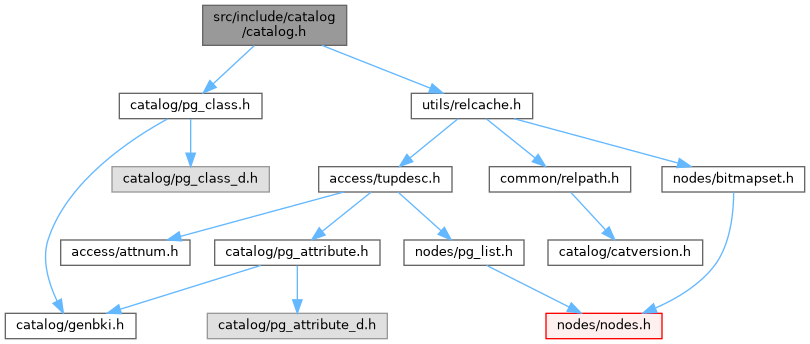

Go to the source code of this file.
Functions | |
| bool | IsSystemRelation (Relation relation) |
| bool | IsToastRelation (Relation relation) |
| bool | IsCatalogRelation (Relation relation) |
| bool | IsInplaceUpdateRelation (Relation relation) |
| bool | IsSystemClass (Oid relid, Form_pg_class reltuple) |
| bool | IsToastClass (Form_pg_class reltuple) |
| bool | IsConflictLogTableClass (Form_pg_class reltuple) |
| bool | IsCatalogRelationOid (Oid relid) |
| bool | IsCatalogTextUniqueIndexOid (Oid relid) |
| bool | IsInplaceUpdateOid (Oid relid) |
| bool | IsCatalogNamespace (Oid namespaceId) |
| bool | IsToastNamespace (Oid namespaceId) |
| bool | IsConflictLogTableNamespace (Oid namespaceId) |
| bool | IsReservedName (const char *name) |
| bool | IsSharedRelation (Oid relationId) |
| bool | IsPinnedObject (Oid classId, Oid objectId) |
| Oid | GetNewOidWithIndex (Relation relation, Oid indexId, AttrNumber oidcolumn) |
| RelFileNumber | GetNewRelFileNumber (Oid reltablespace, Relation pg_class, char relpersistence) |
Function Documentation
◆ GetNewOidWithIndex()
|
extern |
Definition at line 475 of file catalog.c.
References Assert, BTEqualStrategyNumber, CHECK_FOR_INTERRUPTS, ereport, errdetail_plural(), errmsg, errmsg_plural(), fb(), GetNewObjectId(), GETNEWOID_LOG_MAX_INTERVAL, GETNEWOID_LOG_THRESHOLD, HeapTupleIsValid, IsBinaryUpgrade, IsBootstrapProcessingMode, IsSystemRelation(), LOG, ObjectIdGetDatum(), RelationGetRelationName, RelationGetRelid, ScanKeyInit(), SnapshotAny, systable_beginscan(), systable_endscan(), and systable_getnext().
Referenced by AddEnumLabel(), AddRoleMems(), AssignTypeArrayOid(), AssignTypeMultirangeArrayOid(), AssignTypeMultirangeOid(), CastCreate(), CollationCreate(), ConversionCreate(), copy_attribute_defaults(), copy_index_constraints(), CreateAccessMethod(), CreateConstraintEntry(), createdb(), CreateForeignDataWrapper(), CreateForeignServer(), CreateOpFamily(), CreatePolicy(), CreateProceduralLanguage(), CreatePublication(), CreateRole(), CreateStatistics(), CreateTableSpace(), CreateTransform(), CreateTriggerFiringOn(), CreateUserMapping(), DefineOpClass(), DefineTSConfiguration(), DefineTSDictionary(), DefineTSParser(), DefineTSTemplate(), EnumValuesCreate(), GetNewRelFileNumber(), insert_element_record(), insert_event_trigger_tuple(), insert_label_record(), insert_property_record(), InsertExtensionTuple(), InsertRule(), LargeObjectCreate(), NamespaceCreate(), OperatorCreate(), OperatorShellMake(), ParameterAclCreate(), pg_nextoid(), ProcedureCreate(), publication_add_relation(), publication_add_schema(), SetDefaultACL(), StoreAttrDefault(), storeOperators(), storeProcedures(), toast_save_datum(), TypeCreate(), and TypeShellMake().
◆ GetNewRelFileNumber()
|
extern |
Definition at line 584 of file catalog.c.
References Assert, RelFileLocatorBackend::backend, CHECK_FOR_INTERRUPTS, RelFileLocator::dbOid, elog, ERROR, fb(), GetNewObjectId(), GetNewOidWithIndex(), INVALID_PROC_NUMBER, InvalidOid, InvalidRelFileNumber, IsBinaryUpgrade, RelFileLocatorBackend::locator, MAIN_FORKNUM, MyDatabaseId, MyDatabaseTableSpace, ProcNumberForTempRelations, RelFileLocator::relNumber, relpath, RelFileLocator::spcOid, and RelPathStr::str.
Referenced by ATExecSetTableSpace(), heap_create_with_catalog(), index_create(), and RelationSetNewRelfilenumber().
◆ IsCatalogNamespace()
Definition at line 259 of file catalog.c.
References fb().
Referenced by AlterTableMoveAll(), check_publication_add_schema(), heap_create(), and RelationBuildLocalRelation().
◆ IsCatalogRelation()
Definition at line 106 of file catalog.c.
References IsCatalogRelationOid(), and RelationGetRelid.
Referenced by _bt_endpoint(), _bt_first(), _bt_lock_and_validate_left(), CacheInvalidateHeapTupleCommon(), check_concurrent_repack_requirements(), check_publication_add_relation(), cluster_rel(), ExecSimpleRelationUpdate(), GlobalVisHorizonKindForRel(), heap_index_delete_tuples(), heap_multi_insert(), index_create(), needs_toast_table(), read_stream_begin_impl(), RelationBuildTupleDesc(), RelationInitTableAccessMethod(), and transformOnConflictArbiter().
◆ IsCatalogRelationOid()
Definition at line 123 of file catalog.c.
References FirstUnpinnedObjectId.
Referenced by check_relation_privileges(), is_publishable_class(), IsCatalogRelation(), IsSystemClass(), populate_compact_attribute_internal(), read_stream_begin_impl(), ReindexMultipleTables(), and ReindexRelationConcurrently().
◆ IsCatalogTextUniqueIndexOid()
Definition at line 158 of file catalog.c.
References fb().
Referenced by is_catalog_text_unique_index_oid().
◆ IsConflictLogTableClass()
|
extern |
Definition at line 242 of file catalog.c.
References fb(), and IsConflictLogTableNamespace().
Referenced by ATAddForeignKeyConstraint(), ATSimplePermissions(), CreateStatistics(), CreateTriggerFiringOn(), DefineQueryRewrite(), is_publishable_class(), IsSystemClass(), pg_class_aclmask_ext(), RangeVarCallbackForAlterRelation(), RangeVarCallbackForPolicy(), RangeVarCallbackForRenameRule(), RangeVarCallbackForRenameTrigger(), RangeVarCallbackOwnsRelation(), renameatt_check(), and truncate_check_rel().
◆ IsConflictLogTableNamespace()
Definition at line 290 of file catalog.c.
References fb().
Referenced by AlterTableMoveAll(), check_publication_add_relation(), check_publication_add_schema(), CheckValidResultRel(), CheckValidRowMarkRel(), IsConflictLogTableClass(), LockViewRecurse_walker(), MergeAttributes(), and pg_namespace_aclmask_ext().
◆ IsInplaceUpdateOid()
◆ IsInplaceUpdateRelation()
Definition at line 185 of file catalog.c.
References IsInplaceUpdateOid(), and RelationGetRelid.
Referenced by CheckValidResultRel(), InitResultRelInfo(), and systable_inplace_update_begin().
◆ IsPinnedObject()
Definition at line 397 of file catalog.c.
References fb(), and FirstUnpinnedObjectId.
Referenced by checkSharedDependencies(), dependencyLockAndCheckObject(), DropTableSpace(), findDependentObjects(), isObjectPinned(), recordSharedDependencyOn(), shdepChangeDep(), shdepDropOwned(), shdepReassignOwned(), typeDepNeeded(), and updateAclDependenciesWorker().
◆ IsReservedName()
Definition at line 305 of file catalog.c.
References name.
Referenced by check_rolespec_name(), CreateRole(), CreateSchemaCommand(), CreateTableSpace(), pg_get_role_ddl_internal(), pg_get_tablespace_ddl_internal(), pg_replication_origin_create(), RenameRole(), RenameSchema(), and RenameTableSpace().
◆ IsSharedRelation()
Definition at line 331 of file catalog.c.
References fb().
Referenced by CacheInvalidateCatalog(), CacheInvalidateHeapTupleCommon(), classIdGetDbId(), DeleteSecurityLabel(), dependencyLockAndCheckObject(), findDependentObjects(), get_object_address(), GetSecurityLabel(), pg_stat_reset_single_table_counters(), pgstat_fetch_stat_tabentry(), RelationBuildLocalRelation(), SetLocktagRelationOid(), SetSecurityLabel(), and UpdateLogicalMappings().
◆ IsSystemClass()
|
extern |
Definition at line 86 of file catalog.c.
References fb(), IsCatalogRelationOid(), IsConflictLogTableClass(), and IsToastClass().
Referenced by IsSystemRelation(), pg_class_aclmask_ext(), RangeVarCallbackForAlterRelation(), RangeVarCallbackForDropRelation(), RangeVarCallbackForPolicy(), RangeVarCallbackForRenameRule(), RangeVarCallbackForRenameTrigger(), RangeVarCallbackOwnsRelation(), ReindexMultipleTables(), renameatt_check(), swap_relation_files(), and truncate_check_rel().
◆ IsSystemRelation()
Definition at line 74 of file catalog.c.
References IsSystemClass(), RelationData::rd_rel, and RelationGetRelid.
Referenced by ATAddForeignKeyConstraint(), ATRewriteTables(), ATSimplePermissions(), CreateStatistics(), CreateTriggerFiringOn(), DefineQueryRewrite(), get_relation_info(), GetNewOidWithIndex(), heapam_index_build_range_scan(), heapam_relation_copy_for_cluster(), index_constraint_create(), index_create(), pg_nextoid(), rebuild_relation(), rebuild_relation_finish_concurrent(), reindex_index(), ReindexRelationConcurrently(), RelationReloadIndexInfo(), RemovePolicyById(), RemoveRewriteRuleById(), RemoveTriggerById(), and systable_inplace_update_begin().
◆ IsToastClass()
|
extern |
Definition at line 228 of file catalog.c.
References fb(), and IsToastNamespace().
Referenced by IsSystemClass().
◆ IsToastNamespace()
Definition at line 277 of file catalog.c.
References fb(), and isTempToastNamespace().
Referenced by AlterTableMoveAll(), check_publication_add_schema(), heap_create(), IsToastClass(), IsToastRelation(), reindex_index(), reindex_relation(), and ReindexRelationConcurrently().
◆ IsToastRelation()
Definition at line 208 of file catalog.c.
References IsToastNamespace(), and RelationGetNamespace.
Referenced by CacheInvalidateHeapTupleCommon(), check_concurrent_repack_requirements(), heap_abort_speculative(), heap_insert(), ReorderBufferProcessTXN(), and ReorderBufferToastAppendChunk().